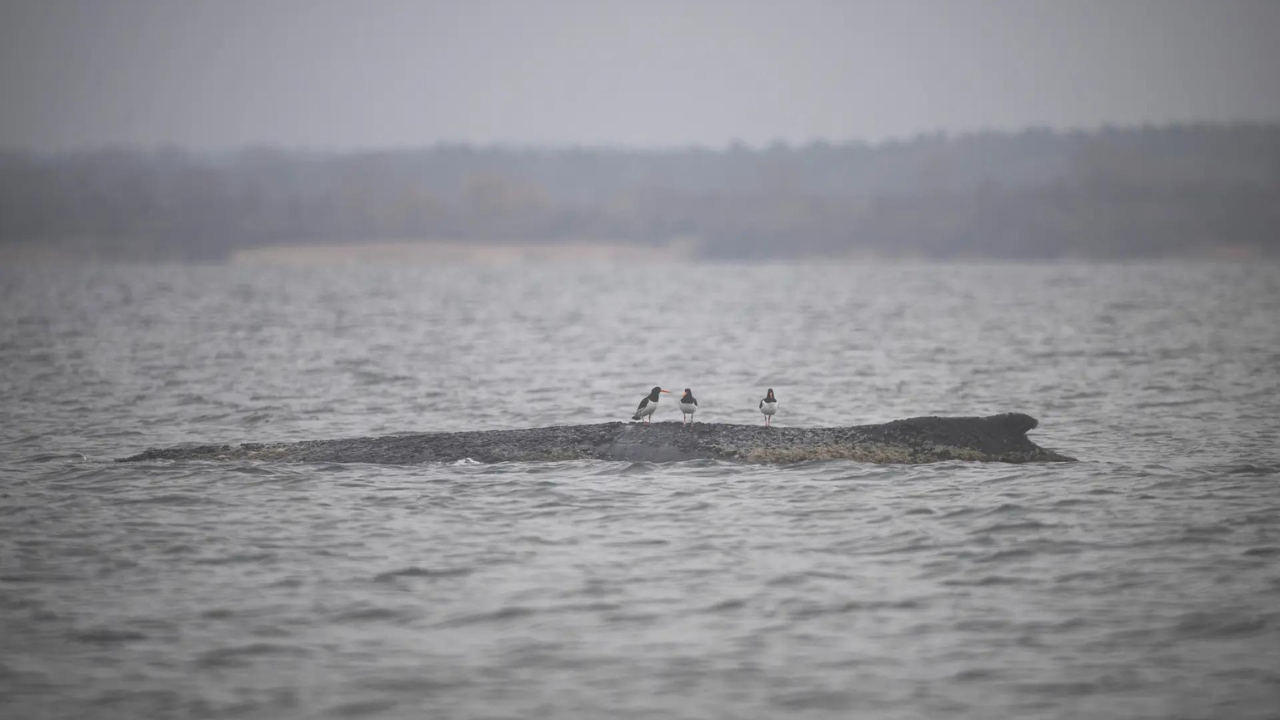
The water in the Baltic Sea isn't like the water in the Atlantic. It is brackish, a thin and tea-colored soup where the salt of the world’s oceans meets the runoff of Northern Europe’s rivers. It is a claustrophobic place for a traveler accustomed to the infinite blue. For a humpback whale, a creature designed for the vast, unmapped highways of the deep, wandering into the Baltic is less of a detour and more of a geographical prison sentence.
A few months ago, a thirty-foot juvenile humpback made a wrong turn. It happens more often than we’d like to admit—a glitch in the internal GPS, a chase after a school of herring that led too far east, or perhaps just the simple, reckless curiosity of the young. This whale, nicknamed "Humpie" by the locals who began to track its progress with bated breath, found itself navigating the shallow, busy shipping lanes of Germany and Poland.
Imagine standing in a crowded, narrow hallway where the ceiling is just an inch above your head. That is the Baltic for a whale. The average depth is barely fifty-five meters. The noise of container ships and ferries thrums through the water like a constant, low-grade headache. It is a sensory minefield.
When the news first broke that a whale was trapped in these dead-end waters, the tone was clinical. Marine biologists noted the salinity levels. Shipping companies worried about collisions. But for those watching from the shore, the stakes were visceral. We saw ourselves in that whale. We knew the feeling of being somewhere we didn't belong, of realizing the path we took has suddenly narrowed until there is no room to turn around.
The danger wasn't just the ships. It was the food. Humpbacks are biological machines built for efficiency. They need massive quantities of krill and small fish to maintain the thick layer of blubber that keeps them alive. The Baltic, while rich in its own right, doesn't offer the high-calorie buffet of the open ocean. Every day the whale spent wandering the coast of Rügen or the Bay of Gdańsk, it was burning through its own life force. It was a ticking clock made of flesh and bone.
Observers reported seeing the whale breaching—hurling its multi-ton body into the air only to crash back down into the gray waves. To a tourist with a camera, it looks like a spectacle. To a biologist, it looks like a desperate attempt to shake off parasites or perhaps just a scream in a language we don't speak. It was a display of power in a place where power meant very little against the geography of a closed sea.
Rescue is a misleading word in the context of a creature the size of a city bus. You cannot rope a humpback and pull it to safety. You cannot put it in a net and airlift it back to the North Sea. The only "rescue" possible is a quiet, collective hope that the animal finds the narrow exit on its own. It is a test of patience that most humans find unbearable. We want to intervene. We want to solve. But with a wandering whale, the best thing a human can do is get out of the way.
Then, the silence started.
For several days, the sightings stopped. The radar pings were empty. The local news cycles shifted to other things—politics, weather, the trivialities of the mainland. There was a growing, unspoken fear that the whale had finally succumbed to the exhaustion of the maze. We expected to find it washed up on a beach, a tragic monument to a navigational error.
But whales are older than our maps. They carry a memory of the world that predates our shipping lanes and our borders.
Last week, a group of researchers near the Skagerrak strait—the gateway that connects the North Sea to the Baltic—spotted a familiar dorsal fin. It was him. He had found the needle in the haystack. He had navigated the narrow bottleneck between Denmark and Sweden, moving past the bridge pilings and the heavy traffic, following a scent or a magnetic pull that we can only guess at.
He was thinner. His skin showed the wear of the journey. But he was moving with a purpose that hadn't been there before. He wasn't wandering anymore; he was traveling.
The moment a whale leaves the Baltic and enters the deeper, saltier waters of the Skagerrak, the physics of its world change. The buoyancy returns. The pressure on the lungs feels right again. It is the oceanic equivalent of taking off a pair of shoes that are three sizes too small.
There is a specific kind of relief in seeing something survive a mistake. We live in a world that is increasingly unforgiving of a wrong turn. We track our locations with satellites and our lives with schedules. We have forgotten what it means to be lost and then, through sheer persistence and a bit of luck, to be found.
The humpback didn't need a map. He needed the water to get deeper. He needed the salt to sting his skin. He needed the horizon to stop being a shoreline and start being a promise.
As he slipped beneath the surface, heading toward the cold, rich feeding grounds of the North Atlantic, he left behind a group of people who were suddenly, inexplicably lighter. He wasn't just a "Baltic stray" anymore. He was a survivor of the maze. He had proven that even when the walls close in and the path seems to disappear, the exit is still there, waiting for the tide to turn.
The ocean is big enough to swallow his story now. He is back in the blue, where the only thing that matters is the next breath and the vast, unblinking stars above the waves. He is free, and in his wake, the world feels a little larger than it did yesterday.