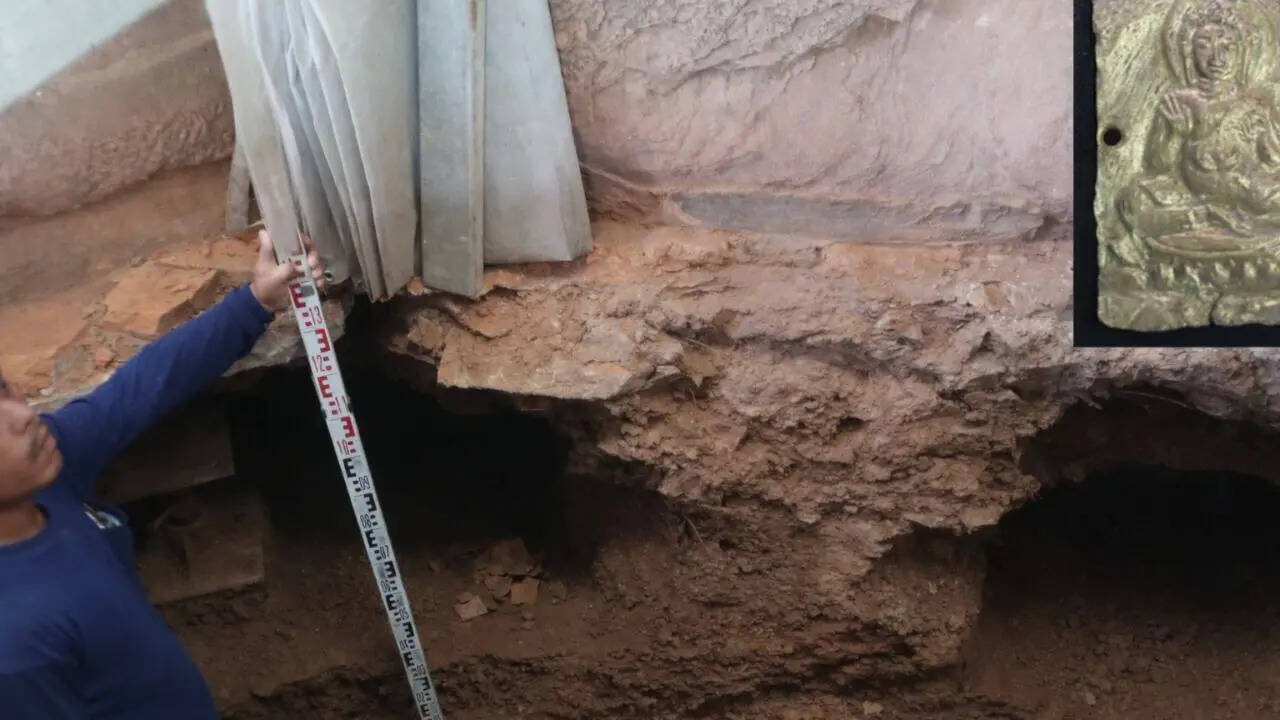
The discovery of a gold cache hidden inside a 1,300-year-old Buddha statue in Thailand is not just a win for archaeology. It is a revelation of how the Dvaravati era elite viewed spiritual merit, survival, and the preservation of wealth. While initial reports focused on the shock of the find, the real story lies in the sophisticated engineering used to conceal these treasures for over a millennium. This was no accident of history. It was a deliberate, high-stakes concealment.
Archaeologists working in the central provinces of Thailand recently encountered a hollowed-out chamber within a bronze Buddha figure dating back to the 7th or 8th century. Inside, they found a collection of gold ornaments, precious stones, and inscribed silver plates. To the casual observer, it looks like a buried stash. To an analyst of ancient Southeast Asian geopolitics, it looks like a "merit bank."
The Mechanics of a Thousand Year Secret
Bronze casting in the Dvaravati period was an advanced science. These artisans used the lost-wax method, a process where a wax model is covered in clay, melted out, and replaced with molten metal. To place gold inside a finished statue, the creators had to design a secondary chamber that would not collapse under the heat of the casting process or show visible seams once cooled.
This requires an understanding of thermal expansion and structural integrity that many modern historians have underestimated. The Dvaravati people were not just casting icons; they were building security systems. By sealing the gold within the bronze core, they ensured that the wealth would be protected from two primary threats: theft and time. A solid bronze statue is difficult to melt down without specialized tools, and its religious sanctity provided a psychological barrier against local looters.
Gold as Spiritual Insurance
In the context of 1,300 years ago, gold was not just a currency. It was a physical manifestation of merit. In Theravada Buddhism, which dominated the region, "making merit" by offering precious metals to the sangha (monastic community) was the ultimate path to a better rebirth.
When a wealthy patron commissioned a statue, they often placed their own jewelry or gold coins inside. This wasn't about hiding money from the taxman. It was about tethering their personal essence to the divine image. By placing gold inside the Buddha, the donor ensured their merit would stay active as long as the statue stood. If the statue was buried or forgotten—as many were during the shifts of empires—that merit remained locked in the earth, waiting to be rediscovered.
The Problem With Thailand Looting Crisis
The discovery has reignited a long-standing debate over the security of Thailand’s historical sites. While this particular find was managed by professionals, the reality on the ground is far grittier. For decades, the black market for Dvaravati bronzes has been one of the most lucrative in Asia.
Collectors in Europe and North America often buy these artifacts without questioning their provenance. This creates a direct incentive for illegal excavation. When a looter finds a hollow statue, they rarely preserve the contents for study. They rip the gold out and melt it down, destroying the silver inscriptions that could tell us about ancient trade routes or forgotten dialects.
The Fine Arts Department of Thailand faces a massive uphill battle. They are tasked with protecting thousands of unmapped temple ruins across the central plains. Most of these sites are in the middle of rice paddies or dense forest. The sheer scale of the landscape makes constant surveillance impossible.
Why the 1,300 Year Mark Matters
The 7th century was a pivot point for Southeast Asia. It was the moment when the region moved from small, localized chiefdoms to more complex, urbanized states. The Dvaravati culture, often overlooked in favor of the later Khmer or Sukhothai empires, was the true foundation of modern Thai identity.
The gold found inside these statues often contains traces of mercury or other impurities that act as a chemical fingerprint. By analyzing these trace elements, scientists can trace the gold back to specific mines in the Malay Peninsula or even as far away as India. This proves that 1,300 years ago, the Mekong and Chao Phraya river basins were already part of a globalized economy.
The Technical Reality of Ancient Alloys
We often talk about "bronze" as a monolith. In reality, the Dvaravati smiths were masters of alloy manipulation. They frequently used high-tin bronze, which resulted in a silvery, resonant metal. This material is incredibly brittle and difficult to work with.
To create a hollow chamber for gold without cracking the high-tin shell requires a level of precision that modern industrial foundries would find challenging. It is a testament to the fact that ancient technology was not "primitive" just because it lacked electricity. It was specialized.
The Silver Plates and Lost Languages
The most significant part of the find isn't the gold. It is the silver plates. These often contain inscriptions in Pali or Sanskrit, written in a variant of the Pallava script from Southern India. These plates act as a "time capsule" of the donor’s intent.
Many of these inscriptions have yet to be fully translated. They likely contain the names of kings, queens, and monks who have been erased from the official historical record. Every time we find a cache like this, we add a new page to a history book that was thought to be finished.
The Risks of Public Disclosure
There is a dark side to announcing these finds. Every time a major gold discovery hits the news, "gold fever" spikes in the surrounding villages. Amateur metal detectorists and professional looters flock to the area, hoping to find the "twin" of the statue.
This creates a race against time. Archaeology is a slow, methodical process. Looting is fast. If the government cannot secure these sites immediately after a discovery, they risk losing the entire archaeological context. Once a statue is moved, we lose the data about its orientation, the soil it was in, and the related structures nearby.
The Preservation Dilemma
Restoring a statue that contains gold is a nightmare for conservators. If you open the statue to study the contents, you damage the integrity of the bronze. If you leave it sealed, you risk the gold reacting with the bronze over centuries through a process known as galvanic corrosion.
This is a classic engineering trade-off. Do you preserve the object as it was intended—a sealed vessel—or do you open it to gain knowledge? Most modern museums are leaning toward non-invasive techniques like CT scanning and 3D X-ray imaging. These tools allow us to "see" inside the Buddha without ever touching a hammer to the metal.
Moving Beyond the Shock Value
The headlines like to use words like "shock" and "mystery." But for those who study the region, this is more of a confirmation. It confirms that the Dvaravati were a culture of immense wealth, technical skill, and deep religious conviction.
The gold was never meant to be found by us. It was meant to remain in the void, a permanent offering to the cosmos. By digging it up, we are essentially breaking a 1,300-year-old contract between a donor and their god. That is the ethical weight that archaeologists carry.
The Actionable Truth for Historians
The focus now must shift from the value of the gold to the value of the data. We need to stop treating these objects as "treasures" and start treating them as "documents."
If we want to protect the remaining 1,300-year-old secrets in the Thai soil, the approach must be three-fold:
- Increase funding for the Fine Arts Department specifically for high-tech non-invasive scanning.
- Implement stricter international laws regarding the sale of unprovenanced Southeast Asian bronzes.
- Engage local communities as "guardians" of their own heritage rather than just bystanders to a discovery.
The Dvaravati Buddha is not just a piece of art. It is a sophisticated piece of ancient technology designed to keep a secret for eternity. It worked for over a millennium. Now that the secret is out, the burden of preservation falls on us.
The gold was the bait. The history is the prize.