The air in Taipei doesn’t smell like gunpowder. It smells like exhaust, fermented tofu from night markets, and the humid, electric charge of a tropical afternoon. But if you sit in a boardroom overlooking the neon sprawl of Xinyi District, the conversation carries a different scent altogether. It is the sterile, metallic smell of spreadsheets and unfulfilled promises.
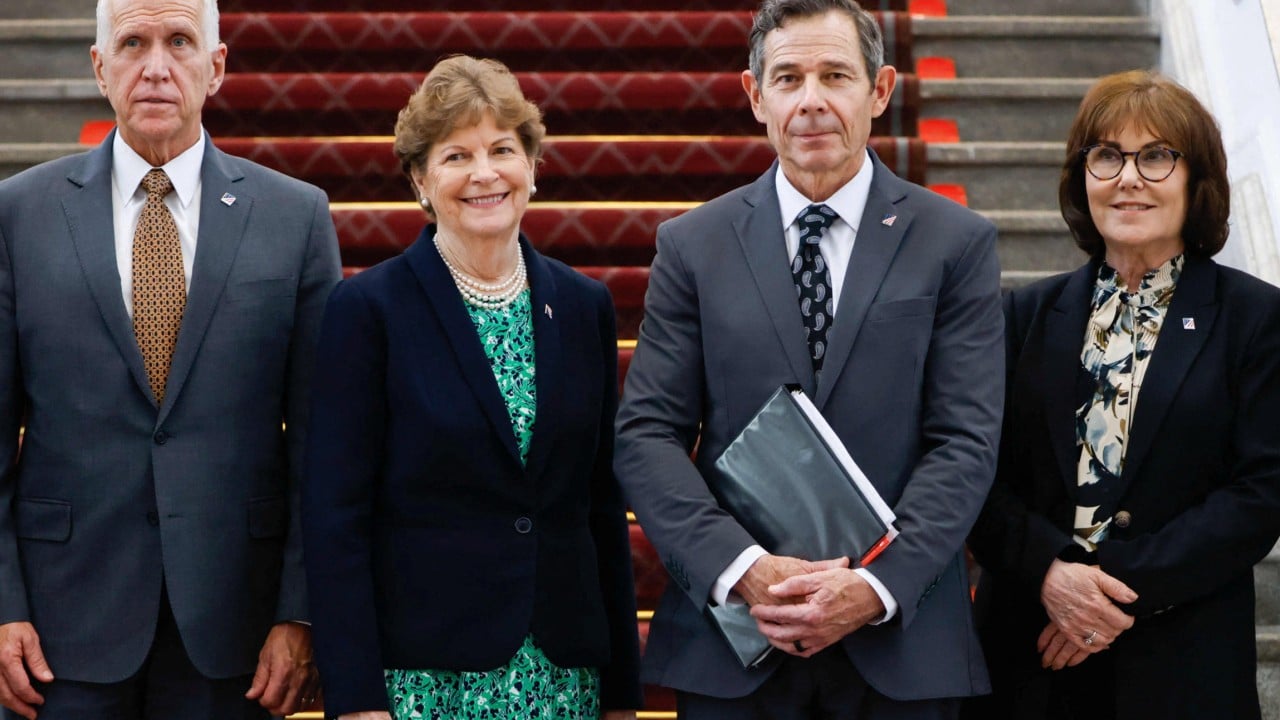
A small group of Americans, men and women in dark suits who look slightly wilted by the Pacific heat, sat across from Taiwanese officials recently. They weren't there for a photo op. They were there because of a ledger. On one side of that ledger is a check for roughly $19 billion. On the other side is a void.
Taiwan has bought the shield. They just haven't received it yet.
Consider the Harpoon missile. In a purely technical sense, it is a sea-skimming, subsonic piece of engineering designed to turn a multi-million dollar warship into a sinking colossus of scrap metal. To a fisherman in the Penghu Islands, however, that missile is something else. It is a ghost. It is the weapon that exists on a signed contract in a filing cabinet in Washington, D.C., but not in the concrete hangars where it belongs.
The delay isn't a matter of simple bureaucracy. It is a symptom of a world that forgot how to build things while it was busy learning how to ship them. Global supply chains, still reeling from the tremors of the early 2020s, have turned the defense industry into a giant game of "waiting for the part." A microchip from one continent, a specialized chemical propellant from another, and a precision-machined casing from a third—if one link snaps, the entire $19 billion assembly line grinds to a halt.
The Mathematics of Survival
The visiting U.S. senators didn't come to Taipei to offer platitudes. They came to talk about the "porcupine strategy." It’s a vivid metaphor for a grim reality. If you are small and your neighbor is very, very large, you do not try to become a bear. You become a creature so painful to touch that the bear decides to look for a meal elsewhere.
To be a porcupine, you need quills.
Right now, Taiwan’s quills are stuck in a backlog. The U.S. defense industrial base is currently juggling the needs of a grinding artillery war in Eastern Europe, a volatile Middle East, and the simmering tension of the South China Sea. Taiwan is standing in a long line, holding a very expensive ticket, watching the clock.
The senators' message was blunt: Taiwan needs to spend more, and they need to do it faster. It sounds contradictory. Why pay more for a line that isn't moving? Because in the world of high-stakes geopolitics, "budgetary commitment" is the only language that echoes loudly enough to cross an ocean. By hiking its defense spending toward 3% of its GDP, Taiwan isn't just buying hardware. They are buying priority. They are trying to cut to the front of the line.
The Invisible Clock
Imagine a hypothetical engineer named Chen. Chen works at a facility near Taoyuan. He knows the specifications of the Abrams tanks and the F-16V fighter jets better than he knows the back of his own hand. He spends his days preparing for the arrival of equipment that has been "incoming" for years.
For Chen, the $19 billion backlog isn't an abstract economic figure. It is the empty space in a hangar. It is the training simulation that remains a simulation because the physical controls haven't arrived. Every day that passes without the delivery of those "quills" is a day where the "porcupine" remains vulnerable.
The pressure isn't just coming from the East. It’s coming from the West, too. The U.S. lawmakers are facing their own internal pressures. They have to explain to voters in Ohio or Arizona why billions of dollars in equipment are being promised to an island thousands of miles away when the domestic manufacturing base is struggling.
But the logic of the Taiwan Strait is unforgiving. It operates on a timeline that doesn't care about election cycles.
The Weight of the Checkbook
The visit was a push for Taiwan to diversify its "asymmetric" capabilities. This is a fancy way of saying: stop buying the big, shiny things that are easy to see and easy to hit. Instead, buy thousands of small, cheap, deadly things.
- Drones that can swarm a fleet.
- Mobile missile launchers that can hide in a mountain tunnel or a parking garage.
- Sea mines that turn a clear blue strait into a lethal maze.
These are the tools of the modern underdog. They are less prestigious than a fleet of shimmering jets, but they are far harder to erase in the first hour of a conflict. The senators are pushing Taiwan to lean into this reality, to move away from the traditional "prestige" military mindset and toward something leaner and more terrifying to an aggressor.
Yet, even these smaller systems are caught in the same web of delays. A drone is just a plastic shell and some spinning blades without the encrypted communication link that allows it to function under electronic interference. And those links require the same rare-earth minerals and advanced semiconductors that everyone else is fighting over.
The Silence in the Room
During these high-level meetings, there is often a moment of heavy silence. It occurs when both sides realize that money, for all its power, cannot conjure time. You can write a check for a billion dollars today, but you cannot buy the three years it takes to train a pilot or the eighteen months it takes to forge a specialized turbine blade.
Taiwan has increased its defense budget significantly over the last few years. It has extended compulsory military service. it has started building its own submarines—a feat of domestic engineering that many experts said was impossible. They are doing the work. But the "arms deadlines" mentioned in news tickers are not just dates on a calendar. They are windows of opportunity that are slowly sliding shut.
The American delegation’s visit served as a physical reminder of a pact. It was a signal to the region that the U.S. is still watching the ledger. But signals don't stop ships. Steel stops ships.
As the senators boarded their plane to leave, the skyline of Taipei remained a testament to what is at stake. It is a city of 2.5 million people who go to work, fall in love, complain about the rain, and worry about their rent. Most of them don't spend their days thinking about $19 billion in backlogged Harpoon missiles or the thickness of the hull on a new submarine. They shouldn't have to.
The true cost of the delay isn't measured in dollars or interest rates. It is measured in the quiet, underlying tension that hums beneath the surface of daily life. It is the price of living in a house where the doors are locked, but the security system is still sitting in a box on a shipping pier halfway across the world.
The ledger remains open. The check has been cashed. Now, the island waits for the ghosts to become solid.