A lecture hall in Paris usually smells of old paper and overpriced espresso. It is a place for the friction of ideas, where the only thing at stake is a grade or a temporary bruise to one’s ego. But lately, the air in these hallowed spaces has turned heavy. It is the weight of a connection that spans thousands of miles, crossing the Mediterranean to link a quiet research lab in France to the high-tech machinery of a conflict that dominates every news cycle.
We often think of war as something made of steel and fire. We see the drones on our screens and the rubble in the streets of Gaza. What we rarely see is the ink. The signatures on partnership agreements. The collaborative data sets. The shared patents. This is the silent architecture of modern struggle, and it is currently being dragged into the bright, harsh light of a French courtroom.
The Architect in the Back Row
Consider a hypothetical student named Elias. He sits in a computational fluid dynamics class at a prestigious French university. He is brilliant. He wants to design more efficient wind turbines to save the planet. But one morning, he discovers that his department shares a "dual-use" research program with an Israeli institution deeply embedded in the development of military surveillance.
Suddenly, the math changes.
The fluid dynamics he is mastering are the same principles used to stabilize a missile in flight or to ensure a surveillance drone can hover silently over a crowded neighborhood. Elias isn't just a student anymore. He is a tiny gear in a massive, international machine. This isn't a conspiracy theory; it is the reality of modern academic networking.
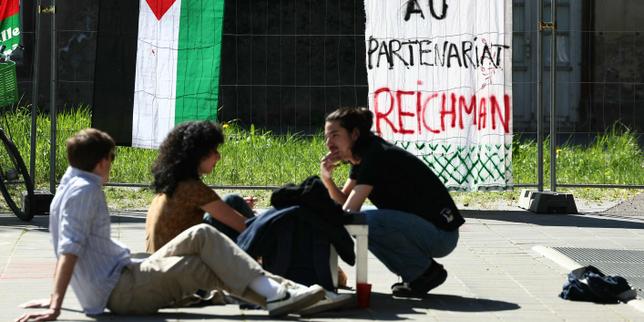
This month, a coalition of human rights organizations and student unions decided that "business as usual" was no longer an acceptable defense. They filed a series of legal challenges against French universities, demanding the suspension of partnerships with Israeli entities. They aren't just protesting; they are litigating.
The Anatomy of a Partnership
University partnerships are the lifeblood of global prestige. They allow for the exchange of brilliant minds and the pooling of resources. In the case of France and Israel, these links are decades deep. They involve heavyweights like the CNRS (National Centre for Scientific Research) and various "Grandes Écoles" that funnel the nation's elite into positions of power.
The legal argument being leveled is precise and devastating.
The plaintiffs point to the International Court of Justice and the mounting evidence of potential war crimes. They argue that by maintaining these ties, French institutions are providing "material or moral support" to an occupation that has been widely condemned. If a lab in Lyon helps refine an algorithm that eventually finds its way into a targeting system used in Gaza, where does the liability end?
It’s a question of proximity.
In the past, academia claimed a sort of "intellectual sanctuary." The idea was that knowledge is neutral. A formula is just a formula. But in 2026, neutrality is a luxury that the legal system is starting to reject. When research has a direct application in the theater of war, the "neutral" scientist becomes an auxiliary.
The Human Cost of Data
While the lawyers argue over the fine print of the French Education Code, the atmosphere on campus is fracturing. This isn't just about high-level policy; it's about the person sitting next to you in the cafeteria.
I spoke with a researcher who requested anonymity—let’s call her Sophie. She has spent five years working on a joint project involving facial recognition technology.
"We started this to help find missing children," she told me, her voice barely a whisper over the clatter of a Parisian bistro. "But the Israeli partner we work with also provides the software used at checkpoints in the West Bank. My code is helping to keep people in a digital cage. I didn't sign up for this. I signed up for science."
Sophie is exhausted. She represents a generation of academics who are realizing that their work doesn't exist in a vacuum. The "seamless" integration of global research—a term often touted by university presidents—has become a trap.
The Legal Tightrope
The French state is in a bind. On one hand, it prides itself on being a beacon of human rights. On the other, it values its strategic and technological alliances with Israel. By bringing this to court, the activists are forcing the government to choose between its rhetoric and its ledgers.
The courts must now decide if these academic agreements violate the French commitment to preventing genocide or complicity in war crimes. It is a staggering burden for a judge. They are being asked to trace the lineage of a thought from a chalkboard in Paris to a weapon in the Middle East.
Critics of the lawsuits argue that cutting ties will only stifle innovation and hurt the very people who might advocate for peace within Israel. They call it an attack on academic freedom.
But freedom for whom?
If the freedom of a French professor to collaborate results in the loss of freedom—or life—for a student in Gaza whose university has been reduced to dust, the scale is fundamentally broken. Every university in the Gaza Strip has been damaged or destroyed. There are no lecture halls left there. No overpriced espresso. Only the silence of the graveyard.
Beyond the Courtroom
This movement is spreading. It isn't just a French phenomenon. From the encampments in the United States to the boardrooms of London, the demand for "disclosure and divestment" has moved from the fringe to the center of the debate.
The invisible paper trail is being followed to its source.
The real power of these lawsuits isn't just the potential for a canceled contract. It is the friction they create. They make it uncomfortable to look away. They turn a "standard partnership" into a liability. They force the people in power to acknowledge that their signatures have echoes.
Imagine the courtroom on the day of the verdict.
The walls are lined with leather-bound books, symbols of a legal tradition that stretches back centuries. The judge looks down at a stack of papers. On one side, the economic benefits of innovation. On the other, the moral imperative of human survival.
The decision won't just change a few university bylaws. It will redefine what it means to be an educator in the 21st century. It will determine whether a university is a greenhouse for the future or a factory for the present conflict.
The ink is still wet.
The lecture halls remain quiet for now, but the students are no longer just taking notes. They are reading the fine print. They are looking at the logos on their lab equipment and the names on their grants. They are realizing that the most powerful weapon in the world isn't a bomb.
It is a choice.
A single hand pauses over a keyboard in a basement lab. The cursor blinks, steady as a heartbeat, waiting for the next command. Outside, the sun sets over the Seine, casting long, sharp shadows that reach toward a horizon most of us will never see, connecting us all in a web of complicity that we are only just beginning to untangle.