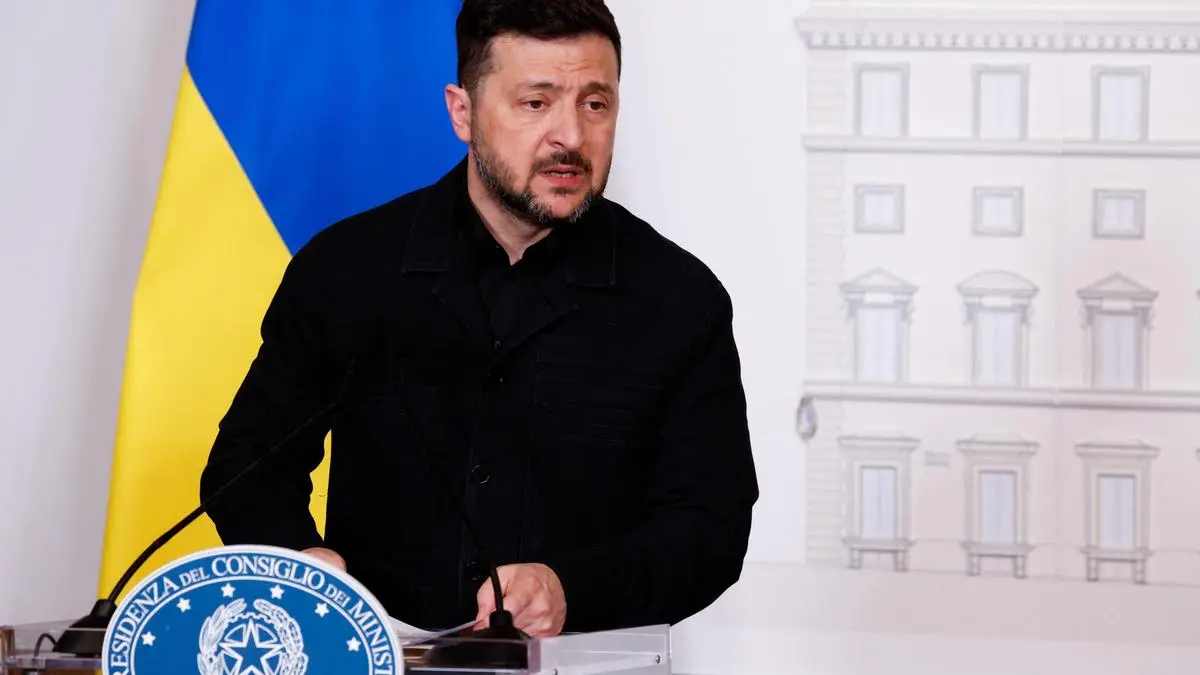
The standard media circuit follows a predictable, exhausting script. Russia launches a massive missile and drone wave. Kyiv’s power grid flickers. President Volodymyr Zelenskiy stands before a camera, exhausted but resolute, and demands "timely aid" and "stronger pressure" on Moscow. The West nods, signs a check for a few more Patriot batteries, and we pretend the needle moved.
It hasn't. For a deeper dive into similar topics, we suggest: this related article.
The obsession with "timely aid" is a strategic distraction. It’s a comfort blanket for a Western defense establishment that prefers shipping crates of hardware over addressing the fundamental shift in 21st-century attrition. We are witnessing the slow-motion failure of the "Arsenal of Democracy" model against a localized, mass-produced, low-cost insurgency mindset.
Sending more $4 million interceptors to shoot down $20,000 Shahed drones isn't a winning strategy. It's a mathematical suicide pact. To get more details on this issue, comprehensive coverage can be read on Associated Press.
The Attrition Delusion
Western analysts love to talk about "pressure." They talk about sanctions, diplomatic isolation, and the seizure of Russian assets. This is the "lazy consensus." It assumes that the Russian state functions like a Western corporation—sensitive to quarterly losses and reputation.
It doesn't.
Russia has successfully transitioned to a total war economy. While we debate the "timely delivery" of a dozen F-16s, the Russian industrial base is churning out artillery shells at a 3:1 ratio compared to the entire NATO alliance. If you think a few more long-range missiles will break the back of a nation that views 300,000 casualties as a manageable demographic dip, you aren't paying attention.
The "pressure" Zelenskiy calls for is a phantom. Sanctions have been bypassed via shadow fleets and gray-market electronics from Shenzhen. The Russian economy is overheating, yes, but it is functional. More importantly, it is producing. The West is merely donating.
The Logistics of Despair
Let's talk about the hardware. The plea for more air defense is logical on the surface, but it ignores the brutal reality of the cost-per-kill ratio.
Imagine a scenario where every time an intruder throws a $5 rock at your window, you have to spend $1,000 to catch it in mid-air. You will run out of money long before they run out of rocks.
- The Interceptor Shortage: Global production of high-end interceptors like the PAC-3 MSE is measured in the hundreds per year. Russia and its partners are firing thousands of munitions. You cannot solve a volume problem with a precision solution.
- The Maintenance Gap: We ship Leopards, Challengers, and Abrams tanks like they are plug-and-play devices. They aren't. They are mechanical nightmares requiring specialized supply chains that don't exist in the Donbas. A tank with a broken turbine is just a very expensive paperweight.
- The Training Lag: "Timely aid" is an oxymoron. By the time a soldier is proficient in a Western weapon system, the tactical reality on the ground has changed. We are teaching 2022 tactics to soldiers fighting a 2026 war.
The bottleneck isn't political will; it's industrial capacity. The West has spent thirty years "right-sizing" its military-industrial base for small-scale interventions. We have forgotten how to build for a meat-grinder.
The Myth of the Silver Bullet
First, it was the Javelin. Then the HIMARS. Then the Leopard tanks. Now it’s the F-16 and the ATACMS.
Each time, the media treats these deliveries as "game-changing" (to use their favorite, banned term). But in a high-intensity conflict, there is no such thing as a silver bullet. There is only the "System of Systems."
Russian electronic warfare (EW) has already learned to jam GPS-guided munitions. The HIMARS strikes that were devastating in late 2022 are now routinely intercepted or diverted. The Russian military is a slow, clumsy beast, but it is an adaptive one. They learn from their failures. The West, meanwhile, is stuck in a cycle of reactive generosity—responding to the last attack rather than preparing for the next year of conflict.
The Strategy Kyiv Actually Needs
If Zelenskiy wants to win, he should stop asking for our leftovers and start demanding our factories.
The obsession with "pressure on Moscow" is a waste of diplomatic capital. The only pressure Russia understands is the physical inability to move forward. That doesn't come from a Patriot battery in Kyiv; it comes from 50,000 FPV drones hitting every moving object within 20 kilometers of the front line every single day.
- Decentralized Manufacturing: Stop waiting for a shipment from South Carolina. Ukraine needs the tech transfer to build its own long-range strike capabilities. If it isn't made in Lviv, it isn't sustainable.
- Electronic Warfare Dominance: The war is currently being won by whoever controls the spectrum. A $10,000 EW jammer is worth more than a $10 million tank right now.
- Asymmetric Escalation: Pressure shouldn't mean more sanctions. It should mean making the Russian energy infrastructure as brittle as Ukraine’s. If the lights go out in Moscow, the conversation changes.
The Hard Truth
The West is treating this war like a charity project. We give what we can spare, when we feel the moral urge, usually after a tragedy.
This "timely aid" is just enough to keep Ukraine from losing, but nowhere near enough to let them win. It creates a perpetual state of "bleeding out." We are subsidizing a stalemate while patting ourselves on the back for our "unwavering support."
The uncomfortable reality is that Russia is prepared for a five-year war. The West is barely prepared for a five-month election cycle. Until the strategy shifts from "helping Ukraine survive" to "retooling the global industrial base to crush Russian capacity," all the speeches in the world won't change the map.
Stop asking for more missiles. Start building the machines that make them.
The time for "urging" is over. The time for industrial brutality is here.