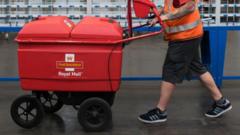
The doorbell doesn't ring much anymore. When it does, it is usually a courier with a barcode and a frantic schedule, not the steady, rhythmic thud of a bundle hitting the hallway floor. But for those waiting on a cancer screening result, a replacement credit card, or a final notice from the council, that letterbox is the most important portal in the house. It is the thin slot where life happens.
Lately, that portal has been quiet. You might also find this similar article interesting: The Mandelson Fixation Is Why British Politics Is Broken.
In South East Cornwall, the silence became so loud that it reached the halls of Westminster. Anna Gelderd, the local MP, decided to step inside the machinery to see why the gears were grinding to a halt. What she found—or rather, what she didn't find—has sparked a row that cuts to the heart of a British institution’s integrity.
The Empty Floor
Picture a sorting office at dawn. Normally, it is a hive of controlled chaos. There should be mountains of gray plastic frames, thousands of envelopes whispering against each other, and the frantic sorting of "flats"—those A4 envelopes that hold the heavy stuff of adulthood. As reported in recent coverage by Al Jazeera, the results are notable.
When Gelderd walked into the Royal Mail delivery office, she expected to see the backlog. She expected to see the physical manifestation of the complaints filling her inbox. Instead, she saw clean floors. Clear desks. A system that appeared, on the surface, to be functioning with surgical precision.
But the postmen and women watching from the sidelines knew a different story.
The allegations that followed were sharp. Staff members, speaking under the veil of anonymity, claimed the pristine scene was a hollow shell. They suggested that the "mountain" had been moved. Specifically, they alleged that undelivered mail—the very backlog the MP was there to investigate—had been loaded into vans and driven away or stashed in "York" containers out of sight before her arrival.
It was, if the claims are true, a masterclass in corporate stage management.
The Ghost in the Machine
Royal Mail has been quick to push back. They call these claims "categorically false." They maintain that no mail was hidden, no vans were used as temporary coffins for delayed bills, and that what the MP saw was the reality of their operation.
However, the disconnect between the official narrative and the lived experience of the residents is vast. Consider a hypothetical resident—let's call her Mary. Mary lives at the end of a winding Cornish lane. She has been waiting three weeks for a hospital appointment letter. She watches the red van pass her gate without stopping, day after day. When she calls the sorting office, she is told there is no backlog.
When an MP visits and sees a clean floor, Mary’s reality is erased. This is the "invisible stake" of the scandal. It isn't just about a late birthday card. It is about the gaslighting of a community. If the authority says the room is empty, but your letterbox remains cold, who are you supposed to believe?
The postal service isn't just a business; it’s a social contract. We pay for a stamp with the implicit trust that the physical object will move from point A to point B in a predictable timeframe. When that contract breaks, the impact ripples through the economy and the mental health of the vulnerable.
The Pressure Cooker
To understand why a manager might even be tempted to "clear the decks" for a VIP visit, you have to look at the crushing weight of modern postal targets.
Royal Mail is currently navigating a brutal transition. They are trying to pivot from a letter-centric business to a parcel-centric one to compete with the likes of Amazon and DPD. Letters are legally mandated under the Universal Service Obligation (USO), but parcels are where the profit lives.
Postal workers often describe a culture of "parcel first." If a van is full and the clock is ticking, the tracked box with the new shoes often takes precedence over the bundle of first-class letters. It’s a triage system. In this high-pressure environment, a visit from an MP isn't seen as an opportunity for honesty; it’s seen as a threat to be managed.
The workers are caught in the middle. They are the ones who have to face the frustrated neighbors. They are the ones who see the piles of mail growing in the corners of the depot on a Tuesday, only to be told to focus on the premium deliveries.
A Culture of Deflection
This isn't the first time Royal Mail has faced accusations of "clearing the floor" for inspectors. Across the country, similar stories have bubbled up—anecdotes of mail being hidden in lockers, or extra staff being drafted in for a single day to create the illusion of efficiency.
The company denies it all. They point to "service improvement plans" and "recruitment drives." They speak the language of corporate recovery.
But the language of the people is different. It’s the language of missed deadlines and "Where is my post?"
Anna Gelderd’s visit was supposed to provide clarity. Instead, it has deepened the mystery. If the office was truly clear, where is the mail? If the office was staged, what does that say about the leadership’s respect for the democratic process?
An MP represents the eyes and ears of the public. If those eyes are shown a curated fiction, the very mechanism of accountability is broken.
The Weight of a Stamp
We often forget how miraculous the postal system is. For the price of a small square of adhesive paper, a message can travel through a labyrinth of sorting machines, airplanes, vans, and bags to reach a specific door in a remote village. It is a feat of engineering and human will.
But that miracle relies on honesty.
The row in Cornwall isn't just a local news story. It is a microcosm of a national crisis. We are watching the slow-motion erosion of a service that binds the country together. When the "clear floor" policy—whether organic or manufactured—becomes more important than the actual delivery of the mail, the service has lost its way.
The workers in that Cornwall office know the truth. They see the mail that didn't go out. They feel the weight of the bags that are still too heavy, even if the MP saw them as light as air.
Tomorrow morning, the red vans will head out again. Some will be full. Some will be half-empty. And thousands of people will stand behind their front doors, listening for a sound that may never come.
The floor might be clean, but the hallway is still empty.