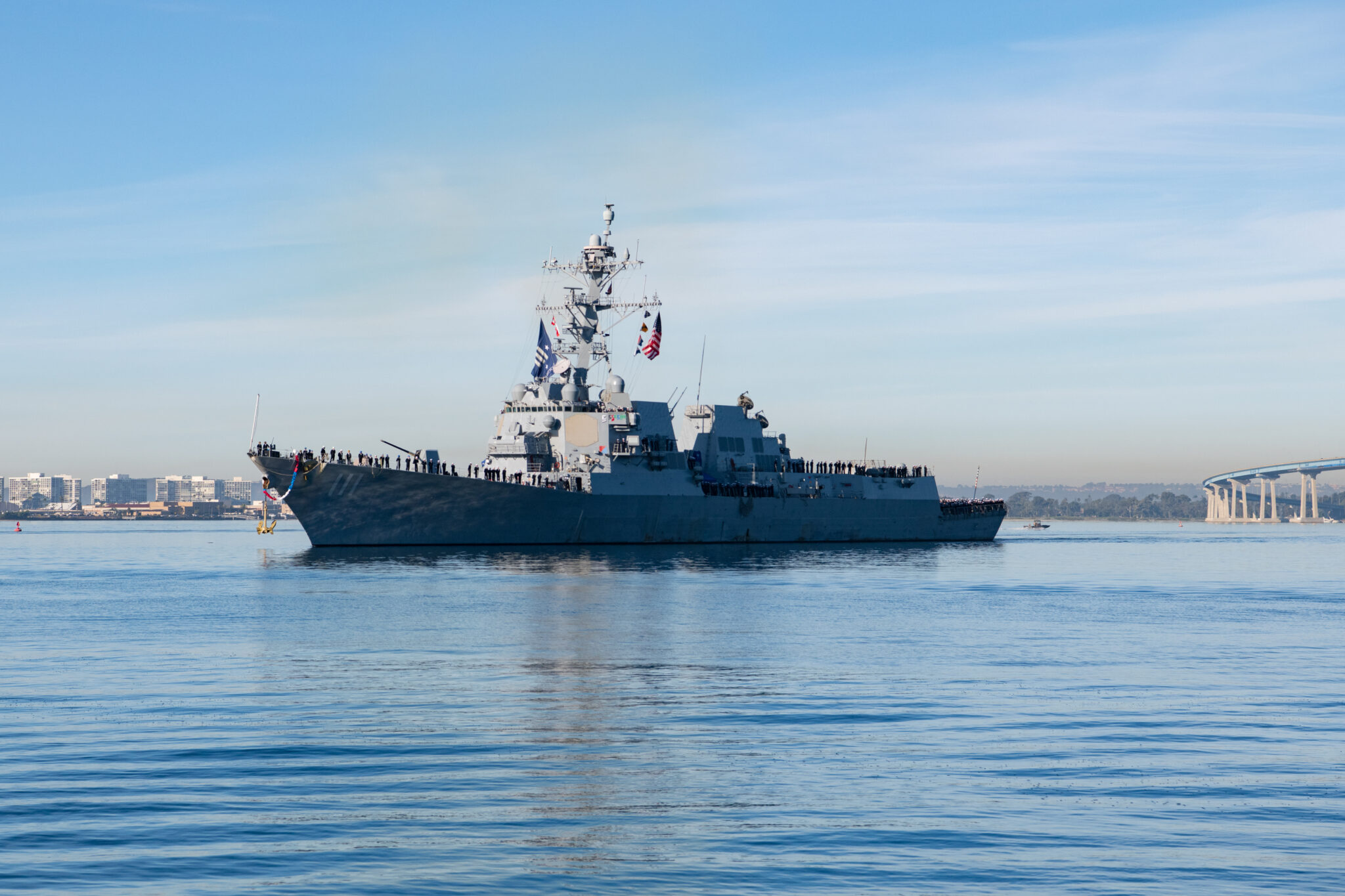
The USS Spruance didn't just move a ship this week. It sent a message that the era of looking the other way at sea is over. US Central Command confirmed that the Arleigh Burke-class destroyer intercepted an Iranian cargo vessel, forcing it to reverse course and abandon its trajectory. This wasn't a polite request. It was a high-stakes standoff in a naval blockade that has turned the region into a pressure cooker.
You’ve probably seen the headlines about "increased tensions." That's a sanitized way of saying the US Navy is now actively physically blocking Iranian logistics. For years, these encounters were mostly shadowboxing—drones flying too close or fast boats buzzing hulls. This is different. When a multi-billion dollar destroyer sits in the path of a merchant ship and says "turn around or else," the rules of engagement have shifted.
What happened on the water
The Iranian vessel was attempting to move through waters currently under a strict maritime blockade. According to reports from CENTCOM, the USS Spruance identified the ship as a violator of specific international sanctions and regional security protocols. It’s important to understand how this works in practice. The Spruance doesn't just show up and start shooting. They use a tiered approach: radio warnings, bridge-to-bridge communication, and finally, physical positioning.
In this instance, the Iranian crew realized that the US wasn't bluffing. They turned the wheel. That moment of retreat is a massive win for US intelligence because it proves the blockade has teeth. If the Iranian ship had pushed through, we’d be talking about a boarding action or a kinetic strike. Instead, we saw a tactical retreat that suggests Tehran isn't ready for a direct naval shooting war just yet.
The hardware behind the blockade
The USS Spruance is a beast. It's built for exactly this kind of power projection. We aren't talking about a patrol boat. We're talking about an Aegis-equipped destroyer capable of tracking hundreds of targets while simultaneously jamming communications. When that ship looms on your horizon, your electronics start acting up and your options disappear.
- Aegis Combat System: This allows the Spruance to see everything within hundreds of miles. There is no "sneaking" past this ship.
- VLS Cells: The vertical launching systems can carry anything from Tomahawks to Evolved Sea Sparrow Missiles.
- Crew Readiness: These sailors are trained for "Visit, Board, Search, and Seizure" (VBSS) operations. They were likely ready to fast-rope onto that Iranian deck within minutes.
Basically, the Iranian vessel was outmatched in every conceivable way. It was a knife fight where one side brought a laser-guided sword.
Why this blockade is different from previous years
Most people think of blockades as something from World War II movies. In 2026, a blockade is about data. The US and its allies are using a massive network of unmanned surface vessels (USVs) and overhead surveillance to track every single hull moving through the Persian Gulf and the Gulf of Oman. You can't just change a ship's name or fly a different flag anymore.
The Iranian cargo ship involved in this incident was likely flagged long before it even reached the Spruance’s visual range. The US military is now operating on a "proactive interdiction" footing. They aren't waiting for a crime to be committed; they’re stopping the logistics of conflict before they reach the destination. This puts Iranian leadership in a tough spot. They either have to stop sending these ships or start escorting them with their own frigates, which would almost certainly lead to a direct clash.
The ripple effect on regional trade
This isn't just about military posturing. It’s about the economy. When the USS Spruance forces a ship to turn back, insurance premiums for every other vessel in that lane go up. Shipping companies hate uncertainty. If the US Navy is actively turning back ships, it means the "safe" lanes are shrinking.
I’ve talked to maritime analysts who think this is the beginning of a much longer campaign. The goal isn't just to stop one ship. The goal is to make the cost of doing business for Iran so high that the internal pressure becomes unbearable. By blocking cargo, the US is hitting the Iranian Revolutionary Guard Corps (IRGC) where it hurts: their wallet. Most of these "cargo" ships are actually front companies for military hardware or sanctioned oil.
Debunking the escalation myth
A lot of critics say these moves "provoke" Iran. That’s a fundamental misunderstanding of the region. In the Persian Gulf, weakness is the greatest provocation. When the US Navy sits back and lets sanctioned vessels pass, it signals that the blockade is a suggestion, not a law. By standing firm, the Spruance actually prevents a larger war by establishing clear boundaries.
The Iranian navy knows the Spruance can sink their entire local flotilla without breaking a sweat. That knowledge is what keeps the peace. It’s a paradox, but it’s the reality of modern naval diplomacy. You keep the guns visible so you don't have to use them.
What to watch for in the coming weeks
The Iranian response won't be a direct attack on a US destroyer. They aren't that reckless. Instead, look for "asymmetric" responses. This usually means mines in the water, drone attacks on "soft" targets like commercial tankers from other nations, or cyberattacks on port infrastructure.
The US Navy is already prepping for this. They’ve increased the presence of mine-sweeping assets and are leanng heavily on Task Force 59, which runs their drone integration program. The cat-and-mouse game just got a lot more dangerous because the mouse now knows the cat is willing to bite.
If you’re tracking this situation, keep your eyes on the shipping manifests and the location of the Spruance’s sister ships. One destroyer is a statement. Three destroyers is a wall. We’re moving toward a wall.
Don't expect the Iranian government to stay quiet about this. They'll claim the ship was carrying food or medicine. They always do. But the fact that the ship turned back without a fight tells you everything you need to know about what was actually in those shipping containers. Security experts aren't buying the humanitarian narrative for a second.
Watch the Strait of Hormuz. That’s the ultimate choke point. If Iran tries to close it in retaliation, the Spruance won't be the only ship making headlines. We’re at a point where a single wrong move by a mid-level Iranian captain could trigger a cascade that nobody can stop. For now, the US holds the high ground, and they're making sure the world knows it.
Follow the updates from US Naval Institute (USNI) News and CENTCOM’s official feeds. Avoid the sensationalist fluff on social media that tries to claim World War III has started every time a radar locks on. Focus on the movements of the Carrier Strike Groups. When those move, the strategy changes. Until then, it’s the destroyers like the Spruance doing the heavy lifting and keeping the lanes clear by force.