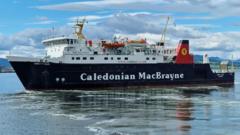
The return of the MV Caledonian Isles to the Arran route after a prolonged technical outage does not signify a return to systemic stability; rather, it highlights a persistent reliance on a "spare capacity deficit" model. CalMac’s operational capability is currently dictated by the Mean Time Between Failure (MTBF) of an aging fleet, where the restoration of a single vessel merely shifts the network from a state of acute crisis to one of chronic vulnerability. To understand the true state of Scottish ferry services, one must look past the immediate relief of resumed schedules and analyze the underlying mechanics of fleet displacement, the economic cost of service degradation, and the technical debt accrued by the Scottish government-owned Caledonian Maritime Assets Ltd (CMAL).
The Triad of Operational Instability
The recent disruption stems from three interconnected failure points that dictate the reliability of the Clyde and Hebrides Ferry Services (CHFS) network.
- Mechanical Obsolescence and Technical Debt: The MV Caledonian Isles is over 30 years old. In maritime engineering, the cost of maintenance scales non-linearly after a vessel passes its 25-year design life. The "repairs" cited in recent reports are often reactive interventions rather than life-extension overhauls. This creates a feedback loop where emergency repairs consume the budget allocated for preventative maintenance across the rest of the fleet.
- The Domino Effect of Vessel Displacement: CalMac operates on a "cascade" strategy. When a major vessel like the MV Caledonian Isles fails, a smaller vessel is pulled from a secondary route (e.g., the Islay or Mull services) to cover the primary demand. This creates a localized economic shock in the secondary route's community. The "better place" the company currently claims to be in is simply the temporary cessation of this cascade, not an increase in total system resilience.
- Infrastructure Incompatibility: New vessels currently under construction in Turkey and at the Ferguson Marine shipyard are not "plug-and-play." They require specific pier geometries and port depths. The delay in port infrastructure upgrades at Ardrossan means that even when new hulls are delivered, the system remains bottlenecked by land-side limitations.
The Economic Cost Function of Service Interruption
The impact of ferry cancellations is often measured in "missed sailings," but a more rigorous metric is the Effective Capacity Loss (ECL). When the MV Caledonian Isles—a high-capacity vessel—is replaced by a smaller chartered catamaran or a displaced fleet member, the ECL can exceed 60% for passenger vehicle space.
The economic consequences follow a predictable decay curve:
- Primary Impact: Immediate loss of tourism revenue and increased haulage costs for local businesses (distilleries, agriculture).
- Secondary Impact: Supply chain "de-optimization." Businesses must hold higher inventory levels to hedge against transit uncertainty, which increases working capital requirements and reduces profitability.
- Tertiary Impact: Demographic erosion. Persistent transit unreliability disincentivizes long-term residency and investment in island communities, leading to a "reliability premium" that inflates the cost of living.
Quantifying "Better" Through Fleet Utilization Metrics
CalMac’s management suggests the network is in a "better place," but this must be qualified against the System Reserve Margin (SRM). In any high-availability transport system, the SRM should ideally sit at 10-15% to account for unplanned maintenance.
Currently, the CHFS network operates with a near-zero SRM. Every vessel is assigned to a specific route with no "hot standby" capability. The return of one vessel to service doesn't create a buffer; it simply fills a hole. The system remains one engine-room fire or gearbox failure away from another total collapse.
The technical challenges faced by the MV Caledonian Isles—specifically issues with its main engines and structural steelwork—are symptomatic of a fleet where the average age is significantly higher than the industry standard for commercial operators. For comparison, private sector short-sea shipping firms typically aim for a fleet age of 15-20 years to maximize fuel efficiency and minimize downtime. CalMac is operating a "geriatric" fleet that requires bespoke parts that are no longer stocked by Original Equipment Manufacturers (OEMs), leading to the long lead times seen in recent months.
The Resilience Bottleneck: Why New Tonnage Isn't a Short-Term Cure
The arrival of the MV Glen Sannox and MV Glen Rosa is frequently cited as the solution to these systemic failures. However, an analytical view reveals three hurdles that will delay the realization of these benefits:
- Crew Familiarization and Training (COI): Transitioning from 30-year-old analog systems to modern Integrated Bridge Systems (IBS) and LNG-hybrid propulsion requires an intensive training cycle. There is a lag between vessel delivery and operational peak.
- The "Teething" Phase: Historically, complex new-builds experience a higher frequency of minor technical issues in their first 1,000 hours of operation. Given the lack of a reserve fleet, if a new vessel experiences a "teething" fault, the system has no way to absorb the shock.
- Port Constraints: The failure to complete the Ardrossan harbor upgrades forces the use of Troon as an alternative. This increases steaming time and reduces the number of possible daily rotations, effectively neutralizing the higher speed and capacity of the new vessels.
Strategic Asset Management: A Path Toward Stability
To move from reactive crisis management to proactive logistics stability, the Scottish transport strategy must pivot toward a Modular Fleet Standardization model.
The current fleet is a "mosaics" of unique, one-off designs. This diversity is an operational nightmare. It prevents the interchangeable use of parts and requires crews to be certified on multiple, vastly different bridge layouts. A standardized fleet of medium-sized, interchangeable vessels would allow for:
- Lower Lifecycle Costs: Bulk purchasing of components and standardized maintenance protocols.
- Fluid Displacement: If one vessel fails, any other vessel in the "class" can take its place without port compatibility issues or crew retraining.
- Predictable Scrappage: A rolling retirement schedule that prevents the "clumping" of vessel ages currently seen in the fleet.
The immediate return of the MV Caledonian Isles buys time, but it does not buy security. The strategic priority must shift from "getting the next boat back" to "building a system that doesn't break when one boat fails." This requires a decoupling of political cycles from maritime procurement cycles. Until the SRM is restored through a combination of standardized new-builds and the retention of older vessels as genuine "hot spares," the Scottish ferry network will remain in a state of precarious equilibrium, susceptible to the smallest mechanical tremor.
The most effective tactical move for stakeholders in the short term is the formalization of a Secondary Route Protection Protocol. This would involve pre-contracting private sector light-freight capacity to ensure that when a "cascade" occurs, the movement of essential goods (food, medical supplies, fuel) is ring-fenced from the fluctuations of the passenger car deck availability. Only by insulating the supply chain from the mechanical health of 30-year-old steel can the Hebridean economy find actual stability.