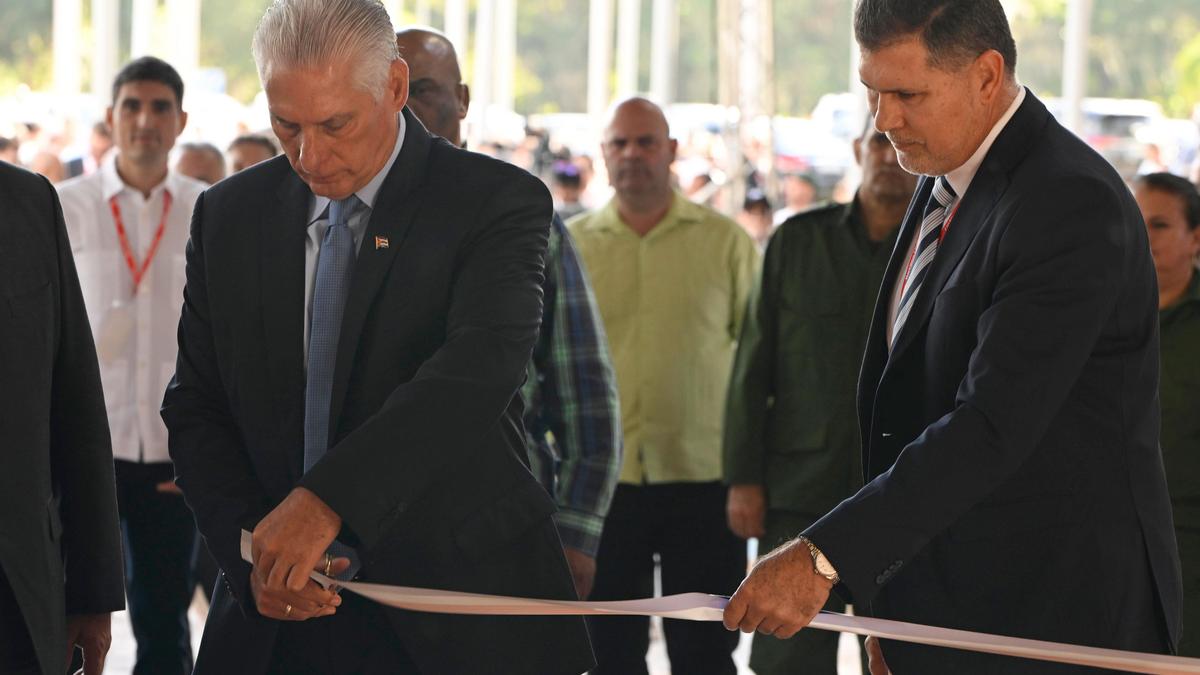
The resumption of high-level diplomatic talks in Havana marks a shift from reactive containment toward a structured engagement model, though the efficacy of these meetings is constrained by asymmetric political objectives. While public discourse often frames these dialogues as "thaws" or "reconciliations," a rigorous analysis reveals a transactional framework driven by three specific pressures: uncontrolled migratory flows, domestic security cooperation, and the economic solvency of the Cuban state. These talks do not represent a shift in fundamental ideology but rather a tactical optimization of a decades-long stalemate.
The Tri-Pillar Framework of U.S. Cuba Engagement
Current bilateral interactions are dictated by three non-negotiable vectors. Each vector operates on a different timeline and carries distinct political risks for both Washington and Havana. For a different perspective, consider: this related article.
1. The Migration Pressure Valve
Migration serves as the primary catalyst for current diplomatic urgency. Cuba is currently experiencing its largest migratory exodus in six decades, surpassing the combined totals of the 1980 Mariel boatlift and the 1994 rafter crisis. The logic here is a direct cause-and-effect loop: systemic economic failure in Cuba leads to domestic instability, which Havana manages by allowing—or incentivizing—mass departure. This creates a logistical and political bottleneck for U.S. border management systems.
From a strategic perspective, the U.S. objective is to restore the 1994 and 1995 Migration Accords. These agreements rely on a "safety valve" mechanism where the U.S. issues 20,000 immigrant visas annually in exchange for Cuba accepting deportees via "repatriation flights." The failure of this mechanism leads to a surge in irregular maritime and overland arrivals, which carries a higher political cost for the U.S. executive branch than the cost of sitting at the negotiating table with an adversary. Further insight on this matter has been shared by BBC News.
2. Transnational Security and Intelligence Decoupling
The second pillar involves the technical cooperation between law enforcement agencies. This includes maritime drug interdiction, human trafficking prevention, and aeronautical safety. These are "low-politics" areas where both sides find a rare alignment of interests.
The bottleneck in this pillar is the U.S. State Department’s "State Sponsors of Terrorism" (SSOT) designation. This designation functions as a financial blockade, preventing Cuba from accessing the international banking system. While Havana demands removal from the list as a prerequisite for deeper cooperation, Washington utilizes the designation as a high-value bargaining chip to extract concessions on human rights and the release of political prisoners.
3. Economic Insolvency and the MSME Pivot
The Cuban economy is currently operating under a regime of "centralized scarcity." The state has shifted from a total monopoly to allowing "Micro, Small, and Medium Enterprises" (MSMEs).
This creates a complex analytical problem for U.S. policymakers:
- The Pro-Engagement Hypothesis: Supporting the nascent private sector will create a middle class independent of the Communist Party, eventually leading to political pluralism.
- The Hardline Hypothesis: MSMEs are a "Trojan Horse" controlled by state-aligned actors to bypass sanctions and secure hard currency for the regime.
The Cost Function of Continued Sanctions
To understand why these meetings are happening now, one must quantify the cost of the status quo. The U.S. embargo (el bloqueo) is not a static wall but a dynamic set of regulations that creates specific market distortions.
The primary mechanism of the embargo today is the restriction on U.S. dollar transactions. This creates a "Risk Premium" for any foreign entity doing business with Cuba. Because the U.S. Treasury (OFAC) can levy multi-billion dollar fines on international banks, most institutions "de-risk" by refusing to process any Cuban-linked funds.
This financial isolation produces a predictable cascade:
- Energy Poverty: Cuba cannot secure long-term credit for fuel or infrastructure repair, leading to the collapse of the national power grid (SEN).
- Agricultural Decline: Lack of hard currency for fertilizer and equipment leads to a reliance on food imports, which currently account for nearly 80% of domestic consumption.
- Inflationary Spiral: The gap between the official exchange rate and the informal market rate erodes the purchasing power of state-employed workers, further fueling the migration vector.
Logical Fallacies in Modern Diplomatic Narrative
Public reporting frequently collapses the complexity of these talks into a binary of "success" or "failure." This is a fundamental misunderstanding of diplomatic inertia.
The first fallacy is the "Linear Progress" assumption—the idea that every meeting moves the needle closer to normalization. In reality, the relationship is cyclical. Each concession by Washington (e.g., restoring family remittances) is often met by a hardening of internal security measures in Havana to signal that economic opening does not equal political surrender.
The second fallacy is the "Homogeneous Actor" error. Neither the U.S. nor the Cuban government acts as a single mind. In the U.S., the policy is fragmented between the White House (focused on regional stability), Congress (focused on electoral politics in Florida), and the State Department (focused on long-term institutional goals). In Cuba, there is a visible friction between the "reformist" economic managers and the "orthodox" military-intelligence apparatus (GAESA) which controls the most profitable sectors of the economy.
The Mechanics of the SSOT Designation
The State Sponsor of Terrorism list is the most significant structural barrier to any meaningful shift in the relationship. Unlike the embargo, which requires an Act of Congress (Helms-Burton) to fully lift, the SSOT is an executive designation. However, the legal requirements for removal are stringent: the President must certify that the government has not provided support for international terrorism during the preceding six-month period and has provided assurances that it will not do so in the future.
The current friction point is the presence of ELN (National Liberation Army) negotiators in Havana. While the Colombian government has requested their presence for peace talks, their presence on Cuban soil remains the technical justification used by U.S. hawks to maintain the designation. Removing Cuba from the list without a significant quid pro quo—such as the release of all 1,000+ political prisoners—would be seen as a domestic political liability for any U.S. administration.
Strategic Divergence in Humanitarian Assistance
Recent talks have touched upon humanitarian aid, particularly in the wake of natural disasters and the failing power grid. The delivery of aid reveals the deep distrust in the logistics chain. The U.S. prefers delivering aid through non-governmental organizations (NGOs) to ensure it does not bolster state institutions. Havana, conversely, views such "direct-to-people" aid as an infringement on sovereignty and a tool for subversion.
This creates a stalemate where aid is offered under conditions one side cannot accept, and requested under terms the other side will not grant. The result is a sub-optimal outcome for the Cuban civilian population, which experiences the physical manifestations of this diplomatic friction through chronic shortages of medicine and basic caloric requirements.
Mapping the Escalation Ladder
If these talks are to move beyond administrative maintenance, both parties must navigate a specific escalation ladder of concessions.
- De-escalation Stage: Re-establishing the full range of consular services in Havana. This reduces the pressure on the U.S. southern border by allowing Cubans to apply for visas legally within their own country.
- Stabilization Stage: Removal of Cuba from the list of "Countries Not Fully Cooperating Against Terrorism." This is a lower-tier designation than SSOT but signals a shift in the intelligence relationship.
- Reciprocity Stage: Havana allows U.S. banks to establish correspondent accounts for MSMEs. This would provide a direct line of capital to the private sector while bypassing the state-controlled GAESA conglomerates.
The bottleneck remains the 2021 crackdowns following the July 11 protests. For the U.S. executive branch, any substantial move toward the "Reciprocity Stage" is impossible without a visible reduction in domestic repression in Cuba. For Havana, the security of the one-party state is the paramount objective, and they view any demand for political reform as an existential threat.
Quantitative Impact of Remittance Normalization
Remittances historically served as Cuba's primary source of hard currency, estimated at $3 billion to $4 billion annually before 2020. The current restrictions on the use of military-controlled entities like Fincimex have diverted these flows into informal, untraceable channels.
Restructuring the remittance pipeline to favor private digital platforms is a key tactical goal of the U.S. side. If successful, this would achieve two objectives:
- It provides the liquidity necessary for MSMEs to import goods.
- It starves the Cuban military of the "transaction tax" it previously collected on every dollar sent from the diaspora.
However, the Cuban government has been slow to authorize the necessary licenses for independent financial processors, fearing a loss of control over the national money supply. This creates a situation where both sides are incentivized to cooperate on the problem (lack of hard currency) but are fundamentally opposed on the solution (who controls the flow).
The Geopolitical Shadow of Extra-Regional Actors
A significant variable missing from standard diplomatic reporting is the role of Russia and China. As U.S.-Cuba relations remain stuck in a transactional loop, Havana has sought to diversify its dependency. Russia has provided sporadic fuel shipments and has discussed debt restructuring, while China has provided infrastructure support for the telecommunications sector.
These actors do not seek to solve Cuba’s economic problems but rather to maintain a strategic foothold 90 miles from the U.S. coast. For Washington, this elevates Cuba policy from a regional immigration issue to a global national security concern. The "New Diplomatic Push" is, in part, an attempt to prevent Havana from becoming entirely dependent on Eurasian adversaries, which would present a far greater long-term threat to U.S. interests than the current status quo.
Strategic Forecast and Operational Recommendation
The current diplomatic trajectory suggests a "Low-Ceiling Engagement" model. We should expect incremental progress on administrative issues like civil aviation and postal services, but a continued stalemate on the core issues of the SSOT and the embargo.
The optimal strategy for U.S. interests involves a "Bypass Policy." This entails:
- Maintaining the SSOT designation as a macro-level leverage point.
- Simultaneously creating specific OFAC "General Licenses" that allow for direct investment in verified, independent Cuban MSMEs.
- Formalizing the migration repatriation process to stabilize domestic political optics.
For Havana, the strategic play is "Survivalist Reform." They will likely offer just enough cooperation on migration and security to prevent the U.S. from escalating sanctions further, while internalizing the private sector enough to prevent it from becoming a true political opposition. The success of the current talks will not be measured by a grand treaty, but by the prevention of a total systemic collapse that would force a chaotic, rather than managed, transition.