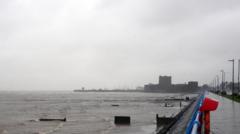
Storm Dave didn’t break the grid. It just reminded us that the grid is already broken.
The local news is currently flooded with heartwarming stories of utility crews working through the night, the flicker of kitchen lights returning to suburbs, and the "heroic" effort to restore power to 150,000 homes. It is a narrative of resilience. It is also a lie.
Every time we celebrate "restoration," we are actually celebrating our dependence on a centralized, 19th-century architecture that is fundamentally incompatible with the 21st century. We are patting the utility companies on the back for fixing a problem that shouldn't exist in the first place.
If your internet goes down for four days every time the wind hits 50 mph, you switch providers. When your power goes out, you’re told to buy candles and wait for a press release. It is the only industry where catastrophic failure is treated as an act of God rather than a failure of engineering.
The Myth of Hardening the Grid
The "lazy consensus" among policymakers is that we need to "harden" the grid. They want to spend billions of taxpayer dollars burying lines or replacing wooden poles with steel ones.
It is a waste of money.
Burying lines costs roughly $1 million per mile. Even then, you aren't safe from flooding or seismic shifts. More importantly, it doubles down on the "hub-and-spoke" model. In this model, electricity is generated at a massive, distant plant and pushed through thousands of miles of vulnerable copper.
Think of it like the early days of computing. We used to have mainframes. If the mainframe died, the whole office stopped working. We didn't solve that by making the mainframe "harder." We solved it by moving to distributed computing.
The grid needs to stop being a mainframe. It needs to become a mesh network.
Your Utility Provider Is Not Your Friend
Utilities operate on a "cost-plus" model. In many jurisdictions, they make a guaranteed profit on the capital they spend. If they spend $500 million repairing lines after Storm Dave, they often get to bake those costs—plus a healthy margin—into your future rates.
They have no financial incentive to make the grid so resilient that it never breaks. Why would they? Chaos is a line item.
I have spent years looking at utility CAPEX (Capital Expenditure) reports. They are masterpieces of obfuscation. They prioritize "visible" fixes that look good in a 6 PM news segment over the boring, radical decentralization that would actually keep your freezer running during a hurricane.
The Microgrid Reality Check
The real solution isn't "restoration." It's islanding.
An islanded microgrid can disconnect from the main utility during a storm and run on its own local generation—solar, wind, or natural gas turbines paired with massive battery storage. When Storm Dave knocked out the high-voltage transmission lines, a neighborhood with a microgrid wouldn't have even seen the lights flicker.
Why isn't this the standard? Because it destroys the utility's monopoly.
If a town can power itself, it doesn't need to pay the "delivery fees" that make up 30% to 50% of your bill. The technology exists. The economics work. The only thing standing in the way is a regulatory framework designed to protect the incumbent providers from the consequences of their own obsolescence.
The Cost of Staying "Connected"
Let’s look at the actual math of a blackout.
Utilities measure performance using metrics like SAIDI (System Average Interruption Duration Index). After Storm Dave, they’ll brag that their SAIDI numbers are "within historical norms."
But they don't count the $500 worth of spoiled groceries in your fridge. They don't count the lost productivity of 50,000 people trying to work from home without Wi-Fi. They don't count the health risks to the elderly whose medical equipment requires a steady current.
If you added the externalized costs of a four-day blackout to the utility's bill, they would be bankrupt by Tuesday. Instead, we allow them to socialize the losses while they privatize the profits.
Stop Buying the "Green" Distraction
You’ll hear some activists argue that we need more "green energy" to stop storms like Dave. While decarbonization is necessary, it’s a red herring in the context of grid reliability.
Slapping a massive wind farm 200 miles offshore does nothing for you if the transmission line connecting it to your city is snapped by a falling oak tree. In fact, large-scale, centralized renewables often make the grid more fragile because they lack the physical "inertia" of massive spinning turbines in traditional plants, making it harder to balance the frequency when things go south.
The answer isn't just "green." It's local.
- Rooftop solar is a start, but without a grid-forming inverter and a battery, it’s useless in a blackout. Most people don't realize that their solar panels shut off when the grid goes down to prevent "back-feeding" power to the lines (which could kill a line worker).
- V2G (Vehicle-to-Grid) technology is the sleeping giant. A Ford F-150 Lightning can power a house for three days. If 10% of the homes in a neighborhood had EVs with bidirectional charging, the "grid" becomes a giant, distributed battery.
The utilities hate this. It turns consumers into competitors.
The Brutal Truth About "Back to Normal"
The headlines say "Power Restored." They should say "Fragility Re-established."
We have returned to a state of temporary stability. We are waiting for Storm Ed or Storm Frank to do exactly the same thing. We are paying for the privilege of being vulnerable.
If you want to actually fix this, stop asking when the power will be back on. Start asking why you are still tethered to a system that fails every time the wind blows.
Stop waiting for a hero in a bucket truck. Build your own island.
The grid is a ghost. Stop acting like it's a foundation.