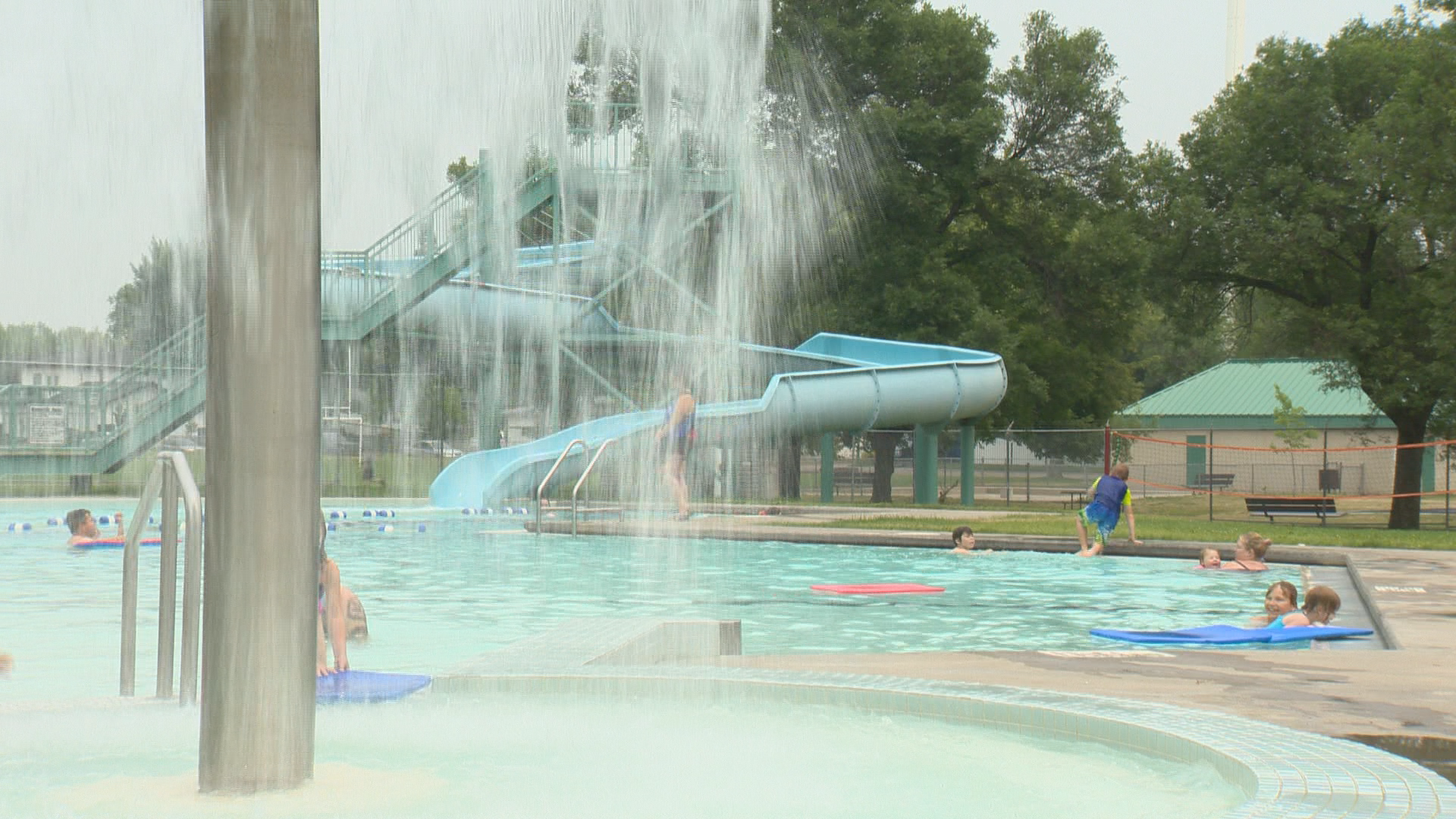
The physical borders of a city rarely align with the lived realities of the people who call it home. For years, indigenous residents living in urban centers have faced a quiet but persistent form of exclusion: the residency requirement for municipal services. A new agreement between the City of Saskatoon and Kakisiwew-Ochapowace First Nation changes that. By allowing Ochapowace members living within city limits to access leisure and recreation facilities at the same rates and under the same conditions as any other resident, the two parties are dismantling a bureaucratic wall that has historically marginalized First Nations people in their own territories.
This is not a gesture of charity. It is a fundamental shift in how municipal governments view their responsibilities toward urban indigenous populations. Traditionally, cities have operated on a rigid tax-assessment model where benefits are strictly tied to property ownership or direct rental addresses within specific zones. However, many First Nations members maintain deep ties to their home communities while living in the city for work, education, or family. Under this new partnership, Saskatoon recognizes that Ochapowace members are integral contributors to the city's social and economic fabric, regardless of whether they are registered on a specific municipal tax roll. For a deeper dive into this area, we suggest: this related article.
The Mechanics of Urban Inclusion
At the heart of the agreement is a streamlined verification process. Instead of jumping through hoops or proving residency via utility bills that might not reflect their living situation, Ochapowace members can now use their status cards or nation-provided identification to access city-run gyms, pools, and rinks. This removes the "non-resident" surcharge, a financial penalty that often makes municipal recreation inaccessible for families already facing economic pressures.
The city isn't losing money here. They are gaining users. By lowering the barrier to entry, Saskatoon is filling its facilities during off-peak hours and ensuring that public infrastructure serves the broadest possible demographic. From a purely fiscal perspective, an empty swimming lane earns nothing; a lane occupied by a First Nations youth paying a standard fee contributes to the facility’s operational sustainability. For additional information on this issue, detailed analysis can be read on NPR.
Beyond the Leisure Center
While the headlines focus on gym memberships and swimming lessons, the implications go deeper. This agreement serves as a blueprint for how other municipal services—such as transit, housing support, and library programming—could be restructured. When a city stops viewing First Nations members as "visitors" and starts viewing them as stakeholders, the nature of governance changes.
Ochapowace First Nation has been proactive in ensuring its members are supported even when they are away from the home reserve. This deal is part of a broader strategy to maintain nationhood across geographic distances. It acknowledges that being a member of a First Nation and being a resident of a city are not mutually exclusive identities.
Addressing the Historical Friction
The relationship between urban centers and First Nations has often been defined by jurisdictional disputes. Cities frequently point to the federal government as the party responsible for indigenous welfare, while the federal government often fails to provide adequate funding for those living off-reserve. This creates a "service gap" where individuals fall through the cracks of competing bureaucracies.
Saskatoon is stepping into that gap. By taking direct action, the city is bypassing the federal-provincial finger-pointing that usually stalls progress. They are acknowledging that the people living within their borders are their neighbors, full stop.
Critics might argue that this creates a special class of citizens, but that perspective ignores the historical context of Treaty 6 territory. The city exists on land that was never intended to be a site of exclusion. Reintegrating First Nations members into the public life of the city is an act of honoring the original intent of those treaties—coexistence and mutual benefit.
Economic Ripples in the Community
Recreation is often the first thing cut from a tight budget, yet it is one of the most effective tools for public health and social cohesion. When kids have a place to go after school, the entire community benefits.
- Improved Health Outcomes: Regular access to exercise facilities reduces the long-term strain on the healthcare system.
- Youth Engagement: Sports and recreation provide alternatives to street-level influences.
- Social Connectivity: Facilities serve as hubs where people from different backgrounds interact, breaking down social silos.
The Ochapowace agreement ensures that these benefits are distributed more equitably. It recognizes that the health of the city is tied to the health of all its residents, including those who have been historically overlooked by municipal policy.
The Problem with the Old Model
For decades, the "resident vs. non-resident" binary was a blunt instrument. It worked for people moving from one suburb to another, but it failed to account for the unique legal and social status of indigenous people. Many Ochapowace members pay taxes through their employment and consumption within Saskatoon, yet they were treated as outsiders by the very institutions their labor helped fund.
This agreement corrects that imbalance. It moves away from a "pay-to-play" model of citizenship toward one based on presence and contribution.
Implementation Challenges and Realities
No policy shift is without its hurdles. The success of this initiative depends on the frontline staff at Saskatoon’s recreation centers. Training is required to ensure that the verification process is handled with respect and efficiency. If a member presents their ID and is met with confusion or hostility by a desk clerk, the policy fails regardless of what the contract says.
Furthermore, there is the question of scale. If every First Nation in the region seeks a similar agreement, Saskatoon will need a centralized system to manage these partnerships. However, the Ochapowace deal provides the necessary framework. It proves that the administrative burden is manageable and the social payoff is significant.
Why Other Cities are Watching
Saskatoon isn't the first city to explore these partnerships, but the Ochapowace agreement is notable for its clarity and lack of "sunset clauses." It is a long-term commitment. Urban centers across Canada, from Winnipeg to Edmonton, are struggling with how to better serve their growing indigenous populations. They are watching to see if this leads to higher engagement and better community relations.
The traditional municipal mindset is defensive. It seeks to protect the "taxpayer base" at all costs. But modern city building requires a more expansive view. A city that excludes a significant portion of its population is a city that is hampering its own growth.
The Burden of Proof
One of the most persistent issues in urban indigenous life is the constant need to justify one's presence. Whether it is in a retail environment or a government office, indigenous people are often asked for more documentation and face more scrutiny than their non-indigenous counterparts.
The simplicity of the Ochapowace agreement is its greatest strength. It says: "We know who you are, and you belong here." By removing the need for Ochapowace members to perform a specific type of "residency" for the city, Saskatoon is validating their right to occupy urban space with dignity.
Shifting the Narrative of Governance
This isn't just about a gym pass; it's about the evolution of the Canadian municipality. We are moving toward a model of "overlapping jurisdictions" where cities and First Nations work as partners rather than separate entities. This reflects the reality of 2026, where the "reserve" and the "city" are no longer isolated worlds.
The Ochapowace agreement is a practical application of reconciliation. It doesn't rely on grand speeches or symbolic gestures. It focuses on the concrete ways people interact with their environment every day. It asks a simple question: Can this person go for a swim without being treated like a stranger?
When the answer is finally "yes," the city becomes a little more whole. The walls don't come down all at once, but one bureaucratic hurdle at a time, the landscape changes. Saskatoon and Ochapowace have shown that the path forward isn't through more regulation, but through more recognition.
Cities that fail to adapt to this reality will find themselves increasingly disconnected from their own residents. The "Saskatoon Model" offers a way out of the old friction, replacing exclusion with a straightforward acknowledgement of shared space and shared humanity. It is time for every municipal council to look at their residency bylaws and ask who they are actually protecting, and who they are leaving out in the cold.