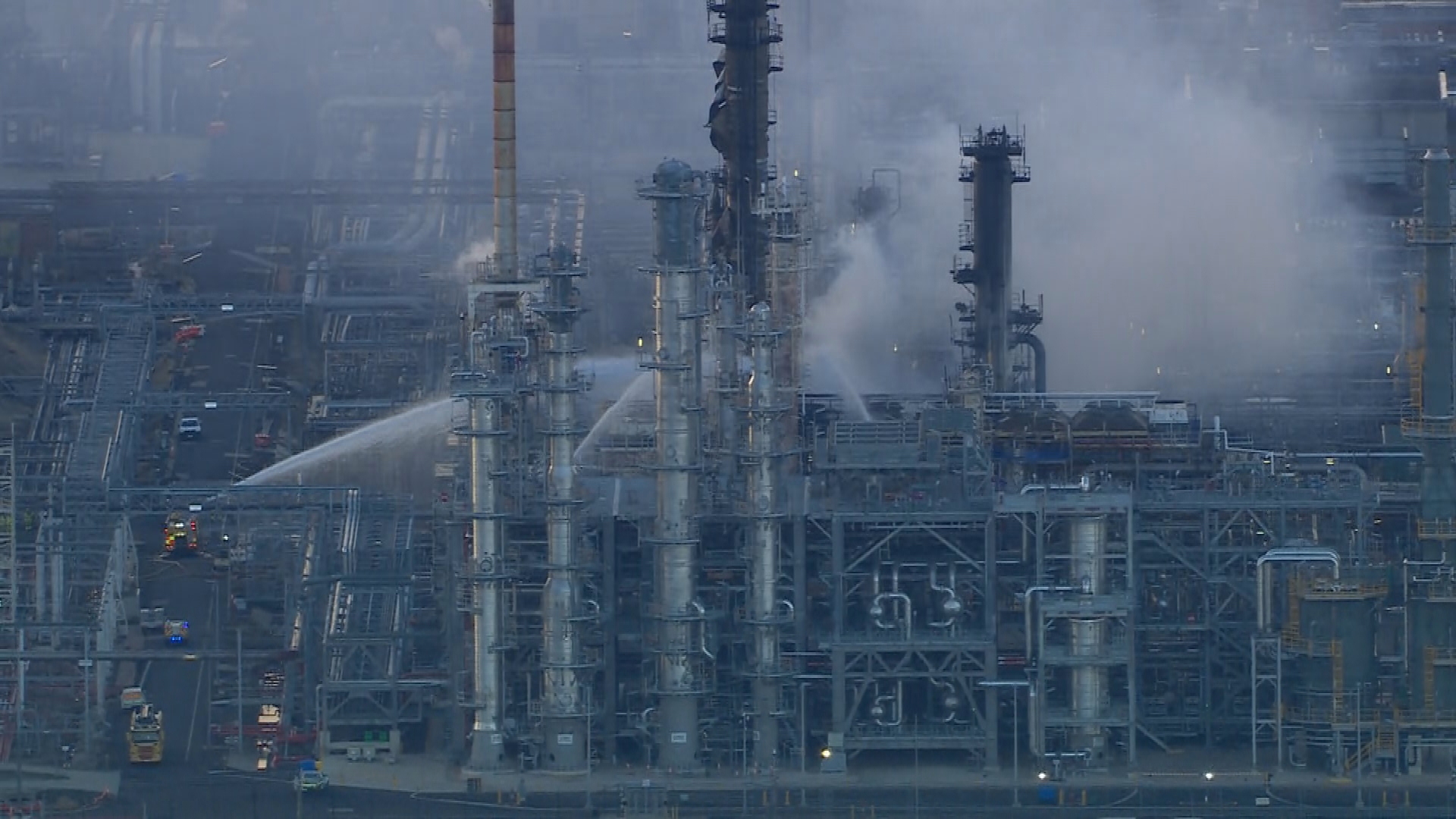
The total loss of a primary refining asset represents a catastrophic decoupling of national energy security from operational reality. When an energy minister acknowledges a "worst-case scenario" following a refinery blaze, they are describing a terminal failure in the multi-layered defense systems designed to contain thermal runaway and hydrocarbon ignition. This failure is rarely the result of a single spark; it is the culmination of systemic entropy, where maintenance deficits, aging metallurgy, and inadequate suppression protocols converge. Analyzing this event requires moving beyond political rhetoric to quantify the structural and economic variables that dictate the recovery timeline and the resultant market distortions.
The Triad of Refined Product Volatility
A refinery fire does not merely destroy physical equipment; it severs a critical node in the supply chain, triggering a three-phase destabilization process.
- Immediate Supply Contraction: The removal of daily throughput capacity (measured in barrels per day or bpd) forces an immediate reliance on strategic reserves or high-cost imports. This shift is not instantaneous, creating a "delivery lag" where local stocks dwindle before replacement molecules arrive.
- Product Grade Disparity: Refineries are tuned to specific crude slates and output requirements (e.g., Euro V diesel vs. high-octane gasoline). A fire in a secondary processing unit, such as a Fluid Catalytic Cracker (FCC), destroys the ability to produce high-value light products, even if the primary atmospheric distillation unit remains intact.
- Logistical Bottlenecking: Inland refineries often serve as hubs for pipeline networks. When the hub is neutralized, the infrastructure becomes "stranded," requiring a pivot to truck or rail transport, which increases the landed cost of fuel by orders of magnitude due to lower volumetric efficiency.
Thermal Degradation and Structural Integrity Assessment
The ministerial admission of a "worst-case" outcome implies that the fire reached temperatures exceeding the critical threshold for structural steel. Carbon steel begins to lose significant yield strength at approximately 400°C and retains less than 50% of its load-bearing capacity at 600°C.
Metallurgical Failure Modes
The primary challenge in post-fire recovery is not just replacing charred pumps, but diagnosing the "invisible" damage to pressure vessels and piping.
- Hydrogen Attack: High-temperature exposure can cause hydrogen to permeate the steel lattice, leading to internal decarburization and cracking.
- Creep and Deformation: Sustained heat under pressure leads to permanent elongation of components, rendering precision fittings and seals useless.
- Quench Cracking: If firefighting efforts involve rapid cooling with high-volume water monitors, the resulting thermal shock can cause brittle fractures in components that might have otherwise survived the heat.
Economic recovery is gated by the "long-lead item" problem. Large-scale reactor vessels or specialized heat exchangers often have manufacturing lead times exceeding 12 to 18 months. If the fire has compromised the core distillation column, the facility is effectively decommissioned for a multi-year window, regardless of the available capital.
The Cost Function of Energy Substitution
When domestic refining fails, the state enters a "Substitution Trap." The cost of importing finished petroleum products is dictated by international benchmarks (like Brent or WTI) plus the "crack spread"—the profit margin refiners charge to turn crude into fuel.
$Cost_{total} = (P_{global} + S_{crack} + L_{logistics}) \times V$
Where:
- $P_{global}$ is the global crude price.
- $S_{crack}$ is the prevailing market crack spread.
- $L_{logistics}$ is the premium for unplanned transport.
- $V$ is the volume required to meet national demand.
This equation demonstrates that the "worst-case scenario" is not just the loss of the refinery, but the exposure of the national economy to global price volatility without the "buffer" of domestic value-added processing. The fiscal drain is compounded if the national currency is weak against the USD, as oil is priced globally in dollars.
Systemic Risk and the Swiss Cheese Model
The minister’s admission suggests a failure of the "Swiss Cheese Model" of accident causation. In high-hazard industries, safety is maintained by multiple layers of redundancy (engineered systems, operational procedures, and emergency response). A catastrophic blaze occurs only when the "holes" in these layers align.
The first layer of failure is typically Mechanical Integrity. This involves the failure of a seal, a pipe wall thinning due to corrosion under insulation (CUI), or a faulty valve. The second layer is Detection Failure—where gas sensors or flame detectors fail to trigger an automated shutdown. The final layer is Containment Failure, where fireproofing on structural members or active foam suppression systems fail to isolate the fire to its point of origin.
An investigation that stops at "an accidental spark" misses the systemic reality. The true cause is the management decision-making process that allowed the holes in the safety layers to grow. This often manifests as "normalized deviance," where small leaks or skipped maintenance cycles become accepted as part of daily operations until the system reaches a tipping point.
Strategic Reserve Depletion and Refill Dynamics
In the immediate aftermath of a refinery loss, the government must draw down Strategic Petroleum Reserves (SPR). This is a high-risk maneuver. While it stabilizes prices in the short term, it leaves the nation vulnerable to secondary shocks, such as geopolitical instability or shipping lane closures.
The decision of when to refill the SPR creates a secondary economic burden. If the government waits for prices to drop, they risk running on "empty." If they refill immediately, they compete with their own import requirements, driving prices higher. This "inventory squeeze" is a primary reason why energy crises following refinery fires tend to be prolonged rather than acute.
Quantifying the Insurance Gap
A common misconception is that insurance will cover the loss. While property damage (PD) and business interruption (BI) insurance provide a financial floor, they rarely account for the full economic fallout.
- Deductibles and Limits: Most industrial policies have massive deductibles and "sub-limits" on specific types of equipment or causes of loss.
- Time-to-Pay: BI claims require extensive forensic accounting that can take years to settle, long after the immediate liquidity crisis has hit the operator.
- Market Reputation: The "uninsurability" of a poorly maintained asset following a major claim can lead to a 300-500% increase in future premiums, permanently altering the facility's OpEx (Operating Expenditure) profile.
Operational Redesign and the Path to Resilience
Restoring the status quo is a strategic error. The "worst possible outcome" provides a grim opportunity to bypass the "sunk cost fallacy" and modernize the infrastructure.
Hardening the Infrastructure
Future resilience depends on moving from reactive to predictive maintenance. This involves the integration of Digital Twins—virtual models of the refinery that use real-time sensor data to predict when a component is nearing its fatigue limit. Replacing manual inspections with continuous ultrasonic thickness monitoring on high-temperature lines can identify the "holes" in the Swiss Cheese Model before they align.
Decentralization of Supply
Reliance on a single, massive refining complex is a fundamental security flaw. The strategy must shift toward a distributed model, incorporating smaller, modular refining units or increased regional storage capacity. This reduces the "Single Point of Failure" (SPOF) risk that led to the current crisis.
The immediate strategic play for the state and the operator is to stop the "rhetoric of tragedy" and start the "logistics of replacement." This requires an immediate audit of all long-lead equipment requirements and the establishment of a "fast-track" procurement channel that bypasses standard bureaucratic delays. Simultaneously, the state must secure long-term supply contracts with offshore refiners to lock in crack spreads before market speculators price in the domestic shortage. If the "worst-case scenario" has indeed occurred, the only viable response is a total mobilization of capital to bypass the damaged asset rather than attempting a cosmetic repair of a fundamentally broken system.