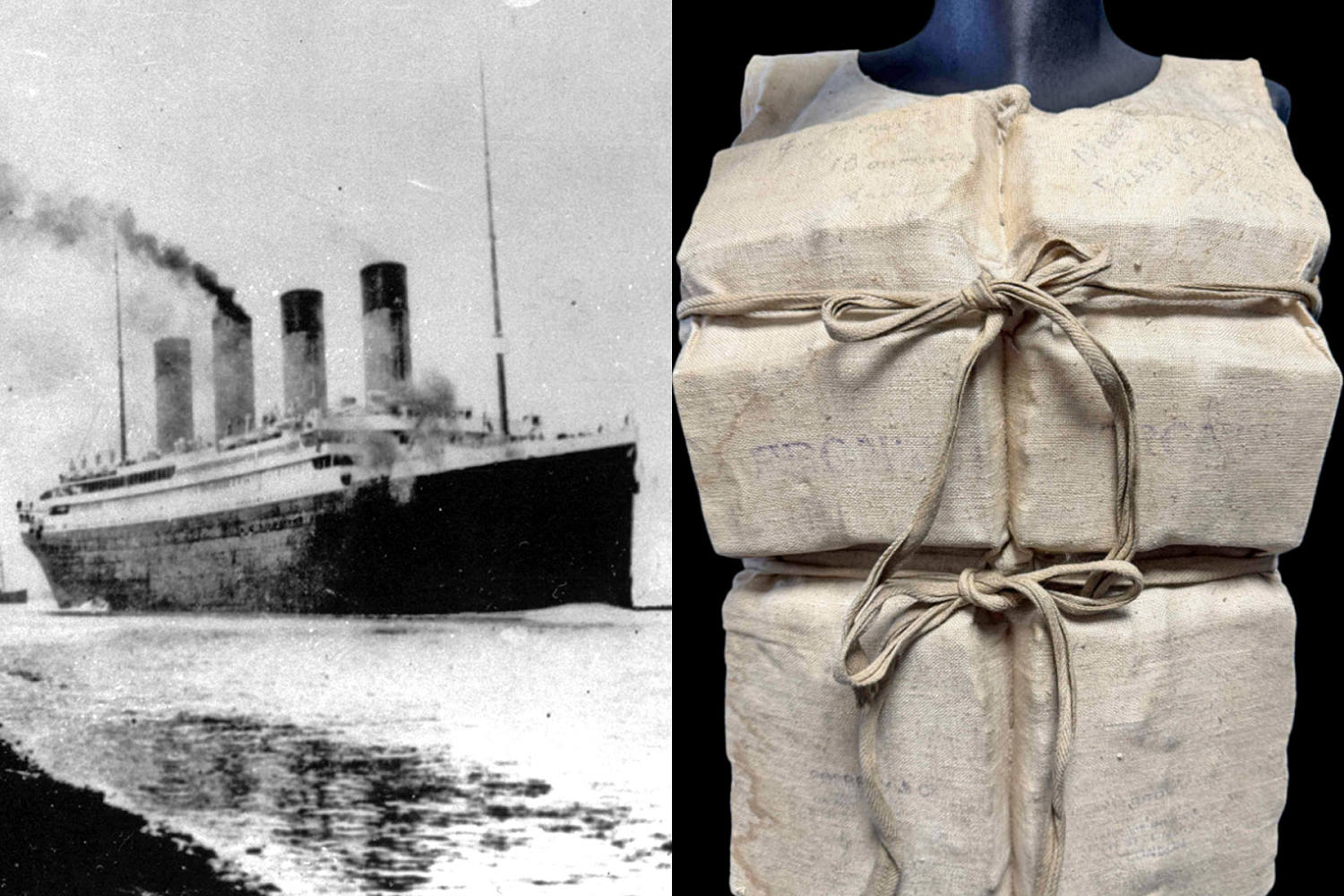
The room is climate-controlled. Air moves in a silent, filtered loop. Under the harsh, focused beams of halogen lights, the item sits inside a glass display case. It is a vest. Not a sleek, modern piece of neon-orange safety gear engineered for maximum visibility, but a relic of a darker era. It is canvas. It is cork. It is stained by a century of time.
Someone has just paid nine hundred thousand dollars for it.
The hammer falls. The transaction is complete. In the eyes of the market, this piece of maritime history has been assigned a definitive numerical value. But look closer. Look past the appraisal price. When you strip away the frantic bidding and the prestige of the provenance, you are left with something haunting. You are left with the physical manifestation of sheer, unadulterated terror.
Consider the mechanics of the object itself.
The Titanic life jacket was not designed for comfort. It was designed for the unthinkable. It was made of heavy, stiff canvas that scratched the skin. Inside, small blocks of compressed cork provided the buoyancy. It was a utilitarian garment, a last-ditch effort to keep a body floating in the freezing North Atlantic, long enough for rescue, or at least long enough to be found. It was never meant to be a trophy. It was never meant to sit in a climate-controlled room.
It was meant to be wet. It was meant to be cold.
When you touch the fabric in your mind, you feel the age. It is brittle now, likely holding the dust of a hundred years. But in 1912, it was flexible, firm, and smelling of salt and damp. The person who wore this did not have the luxury of thinking about its aesthetic qualities. They had seconds.
Imagine the scene. You are on the deck. The slant of the ship is becoming impossible to ignore. The lights are flickering, buzzing with the strain of a sinking city. A crew member—a young man with soot on his face and fear in his eyes—shoves this jacket into your hands. He doesn't tell you to put it on properly; he tells you to put it on now.
You struggle with the straps. Your fingers are numb from the biting air. The canvas is rough against your wool coat. You tie the knots as tight as you can, not because you want to keep the jacket in place, but because you are trying to anchor yourself to the world. You are trying to stay human.
This jacket belonged to someone who survived. Perhaps it was Laura Francatelli, the secretary who climbed into Lifeboat 1 and watched the greatest ship in the world slide beneath the surface. Maybe it was someone whose name has faded from the main headlines, someone who spent the rest of their life never quite escaping the memory of the cold.
When that person stepped into the lifeboat, or perhaps into the water, the jacket became their entire world. It was the barrier between them and the abyss. It was the difference between becoming a statistic and becoming a survivor. To the person wearing it, the jacket was heavy. It was cumbersome. It was the most important thing they had ever owned.
Now, we auction it.
We trade it like a stock. We value it like a rare painting. There is something fundamentally strange about the way we commodify tragedy. We hunger for the physical touchstones of catastrophes. We want the watch that stopped at the exact moment of impact. We want the passenger manifest with the names circled in pencil. We want the life jacket.
Why?
Perhaps we are trying to catch a glimpse of the invisible stakes of history. When we look at a generic artifact—a coin, a piece of pottery—we see the craft of the people who made it. When we look at the Titanic life jacket, we see the desperation of the people who needed it. It is a vessel of empathy. It forces us to confront the reality that for every grand, tragic story we read about in books, there was an individual who simply wanted to go home.
The bidding process reflects a cold, modern detachment. Numbers rise. Hundreds of thousands. Half a million. The stakes shift from the survival of a human being to the acquisition of a status symbol. The gavel strikes.
But does the money really represent the value of the object?
Hardly.
The true value of this jacket is found in the stillness of the room after the auction house clears out. It is found in the way the light hits the stained canvas, revealing the ghosts of the hands that once held it tight. It is found in the weight of the silence.
Think about the engineering of survival. In our modern age, we are obsessed with optimization. We want the best gear, the fastest response times, the most robust safety protocols. We look at this cork-filled vest and we see how far we have come. But we also see how much we haven't changed. We are still just as fragile. We are still just as terrified of the dark, cold water.
The person who survived in this jacket had a life to live after the Titanic. They had breakfasts, and sunsets, and quiet moments of joy. They had bad days, and boring chores, and people they loved. The life jacket was their entry ticket back into that life.
When you buy an object like this, you aren't just buying canvas and cork. You are buying a story of return. You are buying the narrative of someone who looked at the end of everything and somehow, against the odds, found a way to start again.
There is a lesson here, though it is one that requires us to look past the price tag.
We often think of history as something static. We see it in museums, behind glass. We see it as a collection of dates and facts. But history is kinetic. It is the story of people moving through their lives, making choices, and surviving the unexpected. The life jacket is not just a remnant of the Titanic. It is a bridge. It connects us to the sheer, terrifying, beautiful act of existing.
If we truly want to understand the Titanic, we shouldn't just look at the manifest or the wreckage maps. We should look at the things that kept people alive. We should look at the scraps of cloth, the half-finished letters, the pocket watches that still tick in our imaginations.
The market may place a price on this vest. The newspapers may report on the transaction as a curiosity. They might talk about the scarcity of the artifact, the intensity of the collectors, the record-breaking nature of the sale. They will get the facts right, but they will miss the point.
The point is that this jacket saved a life. It performed its duty perfectly. It held firm against the Atlantic.
And now, a century later, it continues to hold something else: our attention. It demands that we acknowledge the fragility of our own existence. It asks us to consider what we would cling to if the lights went out, if the floor tilted, and if the only thing standing between us and the infinite were a few blocks of cork and a bit of hope.
It is a quiet thing. It doesn't scream. It doesn't advertise its history. It just sits there, an unassuming witness to a night that ended everything for so many, but began everything for one.
In the quiet of the auction room, the vest doesn't look like a fortune. It looks like what it always was. A desperate, hopeful, necessary attempt to stay afloat.
Perhaps the real reason we are drawn to such objects is that we recognize our own fragility in them. We are all, in a sense, wearing our own version of this jacket. We are all navigating the current, trying to keep our heads above the water, hoping that when the time comes, we will have enough strength to tie the knots tight, and enough luck to survive the night.
The auction ends. The lights dim. The room empties.
The life jacket remains.
It is silent now, just as it was silent in the darkness of the Atlantic. It is an artifact of survival. It is a testament to the fact that even when the world is sinking, there is a possibility, however slim, of reaching the other side.
It is worth more than money. It is worth the memory of the person who wore it, and the life they went on to lead. And maybe, if we are lucky, it reminds us to cherish the air we breathe, the solid ground beneath our feet, and the people who walk beside us while the tide is still low.
The canvas is frayed. The cork is old. But the story holds. It carries the weight of the Atlantic, the chill of the ice, and the enduring, stubborn, beautiful will to survive.
It is, in the end, the only thing that truly matters.
The vest is put into a crate. The lid is closed.
Outside, the world keeps turning. The sun rises. People go to work. We build our ships, we set our courses, and we move forward into the future, always keeping a watchful eye on the dark, deep water.
We remember. We survive. We hold on.
That is the legacy of the jacket. It is not in the price. It is not in the ownership. It is in the simple, quiet, and profound truth that even in the absolute depths of despair, life is precious, and every second of it is worth fighting for.
Look at the vest one last time.
It is not a museum piece. It is a mirror.
It stares back at us, and for a moment, we see our own reflection in the canvas, and we understand. We are the survivors. We are the ones who are still here. And like the person who wore this jacket, we are all just trying to keep our heads above the waves, holding on as tight as we can, until we find the shore.
The hammer has fallen. The auction is over. But the story of the life jacket is far from finished. It will sit in its new home, a quiet guardian of a memory, waiting for the next person to come along and wonder, just for a moment, what it felt like to be there, to be afraid, and to miraculously, incredibly, live.
It is a heavy thing, this vest.
Not in weight, but in meaning.
And as the lights go out, it remains, a silent anchor in the turbulent, shifting currents of history, waiting for us to learn the lesson it has been trying to teach us for over a hundred years.
Survival is not about the vessel.
It is about the person inside.
The vest rests. The canvas stays still. The history is set.
We move on.
But we never really let go.