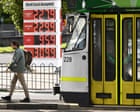
The train doors hiss open at Flinders Street Station, exhaling a crowd of commuters into the cool morning air. Usually, this sound is punctuated by the rhythmic beep-bloop of Myki cards tapping against yellow plastic readers. It is the heartbeat of Melbourne—a constant, digital tally of who is going where and how much they owe for the privilege. But today, and for several days following, that heartbeat has skipped a beat. The readers are silent. The gates are open.
In a move that feels like a rare administrative exhale, the Victorian government has extended the stretch of free public transport across the state. On the surface, it is a logistical announcement, a patch for a technical glitch or a gesture of goodwill during a period of disruption. Beneath the surface, it is a social experiment in movement.
Consider a hypothetical commuter named Elias. Elias spends roughly thirty dollars a week on his commute from the northern suburbs. To a policy analyst, thirty dollars is a rounding error. To Elias, it is three cartons of eggs, or a fresh pair of school shoes for his daughter, or the difference between checking his bank balance with a grimace and checking it with a steady hand. When the state removes the barrier of the fare, it isn't just moving bodies from point A to point B. It is briefly remapping the city’s economy at the kitchen table level.
The city feels different when the gates are open. There is a lightness to the stride of the crowd. The invisible friction of the "tap-on" is gone, and with it, a tiny sliver of daily anxiety. For these few days, the tram belongs to everyone in a way it usually doesn't. The government's decision to extend this grace period acknowledges a simple truth: when things break—be it the ticketing system or the reliability of the lines—the only way to rebuild trust is through a tangible offering of value. It is an admission that the public’s time and patience have a market price.
But as the trains glide silently through the city, the news from the north carries a much heavier silence.
The Shadow in the Hunter Valley
Seven hundred miles away, in the rolling green hills of the Hunter Valley, the narrative of the day takes a sharp, jagged turn. In the town of Cessnock, the air doesn't smell of rain or eucalyptus; it smells of the stagnant, heavy stillness that follows a tragedy. While Victorians are calculating their saved fare, a family in New South Wales is calculating the remainder of a life cut short.
A man has been charged with murder.
The facts are cold. They are clinical. A sixty-year-old man is dead. A thirty-seven-year-old man is in custody. Police tape flickers in the wind, marking a boundary between the "before" and the "after." But a murder charge is never just a legal status. It is the end of a thousand quiet stories. It is a house that will now stay dark at 6:00 PM. It is a phone that will ring in a pocket and never be answered.
The contrast between these two headlines—free trains and a life stolen—is the jarring reality of the Australian news cycle. We live in a country of profound mundane comforts and sudden, inexplicable violence. We are a nation that argues over the price of a bus fare while simultaneously grappling with the dark, domestic shadows that haunt our regional towns.
The detectives in NSW are currently sifting through the "why." They are looking for motives, for triggers, for the sequence of events that leads one human being to decide the world is better off without another. This is the heavy lifting of the justice system, a process that moves with an agonizing, necessary slowness. It is a reminder that while the state can flick a switch and make transport free, it cannot so easily repair the social fabric when it is torn by violence.
The Invisible Stakes of the Everyday
Why do we care about a free train ride in one state and a crime in another? Because both speak to our sense of safety and belonging.
When the Victorian government extends free travel, they are reinforcing a social contract. They are saying: We owe you this. It is an act of accountability. When a man is charged with murder in a quiet town like Cessnock, that same social contract is shattered. It is a declaration that the most basic expectation—the right to exist safely in one’s own space—has been violated.
The news isn't a list of events. It is a map of our collective nerves.
We track the weather. We watch the coastal swells. We see the warnings for the surfers on the Gold Coast and the hikers in the Blue Mountains. We do this because we are trying to predict where the world might hurt us next. The "news live" feed is a digital pulse, a way for us to stay connected to the vast, sprawling reality of a continent that is too big to truly know, but too small to ignore.
Behind every "man charged," there is a neighborhood looking over its shoulder. Behind every "free transport extension," there is a student who can now afford a better lunch. These are not dry updates. They are the rising and falling tides of Australian life.
The Rhythm of the State
In the halls of power, these events are processed into data points. The Victorian transport extension will be analyzed for its impact on foot traffic and retail spending in the CBD. The murder charge in NSW will become a statistic in a report on regional crime rates or domestic incidents.
But for the people living inside the data, the experience is visceral.
There is a specific kind of exhaustion that comes with being a citizen in 2026. We are bombarded with the "important" and the "urgent," often losing sight of the "human." We see the headline about the NSW man and we feel a momentary pang of sorrow, a brief flash of "thank God it wasn't here," before we scroll down to see if the rain will ruin our Saturday plans.
This isn't callousness. It's a survival mechanism.
Yet, if we look closer, we see the connection. The way we treat each other in the small moments—the way we share a space on a crowded, free train—is the foundation of the peace we expect in our homes. The "public" in public transport and the "public" in public safety are the same thing. They are us.
The man in Cessnock is no longer a name; he is a case file. The commuters in Melbourne are no longer individuals; they are "passenger loads." Our task is to refuse that simplification. We must remember that the passenger has a mother, a mortgage, and a favorite song. We must remember that the man in the NSW morgue had a life that was just as complex, just as vibrant, and just as unfinished as ours.
The gates at the station remain open for now. People flow through them like water, a silver stream of humanity moving toward work, toward school, toward the people they love. They move with the quiet, unthinking confidence of those who believe the world will remain predictable.
Further north, under the harsh lights of a police station, that predictability has vanished. The truth of the day lies somewhere in between—in the gratitude for a free ride and the heavy, silent grief for a neighbor lost.
We are a nation of commuters and survivors, constantly moving between the light and the dark, hoping the train we’re on is heading toward a place where the gates stay open and the shadows stay small.