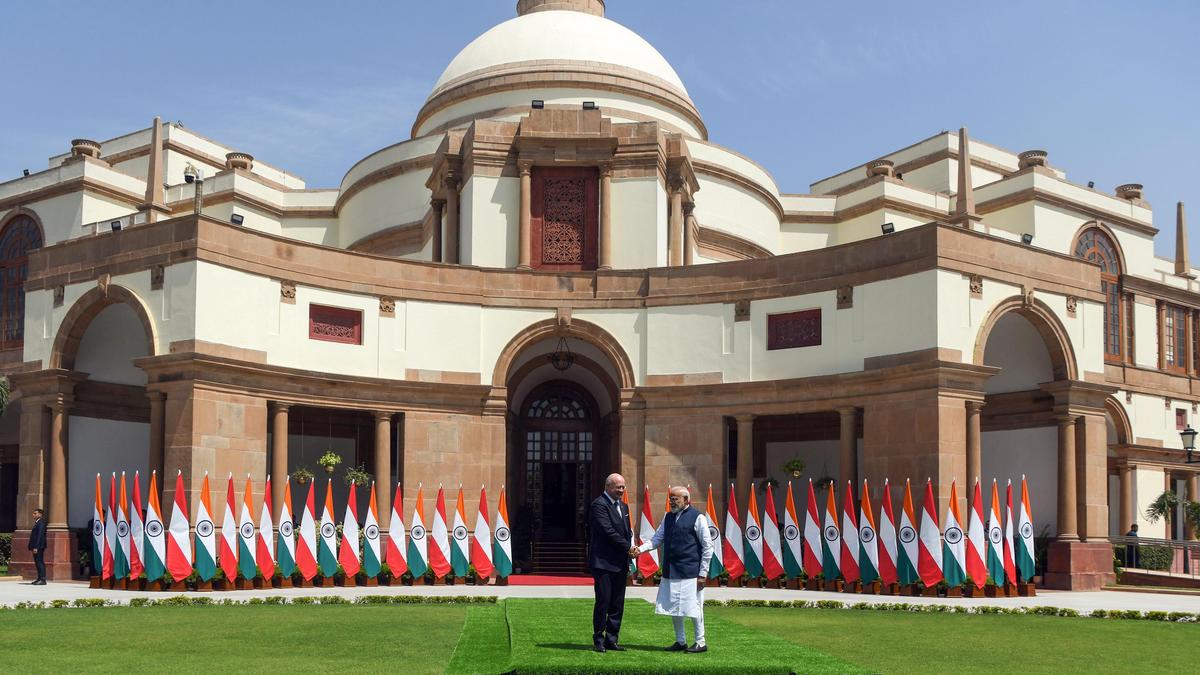
The world is currently addicted to a dangerous hit of hopium. Leaders meet in gilded rooms in Vienna or New Delhi, shake hands for the cameras, and utter the same tired mantra: "This is not an era of war." It sounds noble. It feels moral. It is also a strategic fantasy that ignores every lesson of history and human behavior.
When PM Modi stands alongside the Austrian Chancellor and declares that military conflict cannot resolve problems, he isn't describing reality. He is describing a wish. The hard truth that polite society refuses to acknowledge is that military conflict is often the only thing that resolves problems when the parties involved have fundamentally irreconcilable goals. Diplomacy is just the paperwork we fill out after one side loses the capacity or the will to keep fighting.
The Diplomacy Trap
We have entered a cycle where "dialogue" has become an end in itself rather than a means to an end. This is a gift to aggressors. If you are an expansionist power, there is nothing better than a global community that insists on "peaceful resolution" at all costs. It gives you the one thing you need most: time.
Time to entrench. Time to rearm. Time to wait for the democratic cycles of your opponents to turn over.
The "lazy consensus" suggests that if we just talk long enough, find the right "incentives," or apply enough "diplomatic pressure," the tanks will stop rolling. This is a misunderstanding of power. In the West Asia theater or the plains of Ukraine, we aren't dealing with a misunderstanding that can be cleared up over tea. We are dealing with a collision of primary interests.
Why the "Win-Win" is a Lie
Modern international relations theory is obsessed with the "win-win" scenario. It’s a corporate buzzword that has bled into geopolitics with disastrous results.
- Fact: Many conflicts are zero-sum.
- Fact: Sovereignty is not divisible.
- Fact: Security for one actor often creates an inherent, existential insecurity for their neighbor.
Imagine a scenario where a burglar is in your living room and you decide to "dialogue" him out of the house. You might convince him to only take the TV instead of the jewelry, but you haven't "resolved" the problem. You've just negotiated the terms of your own victimization. True resolution only happens when the burglar is physically removed or realizes the cost of entry is higher than the reward.
The Austrian Neutrality Myth
Seeing the Indian leadership lean on Austrian "neutrality" as a model for modern mediation is a masterclass in missing the point. Austria's neutrality was a byproduct of the Cold War—a forced geographical compromise between the USSR and the West. It wasn't a moral choice; it was a survival tactic.
Relying on "neutral" ground to solve 21st-century conflicts is like trying to use a map from 1955 to navigate a digital minefield. Today’s conflicts aren't about buffer states. They are about ideological hegemony, energy dominance, and the total rewriting of the global order. Neutrality in this context isn't an asset; it's a void that gets filled by whoever is most willing to break the rules.
The High Cost of "Not an Era of War"
The phrase "not an era of war" has become a shield for inaction. When we tell ourselves that war is an anachronism, we fail to prepare for its inevitability.
I have seen organizations and states blow billions of dollars on "de-escalation" initiatives that actually funded the very infrastructure of the next conflict. We send "humanitarian aid" that gets diverted to militias. We provide "dual-use technology" that ends up in drone swarms. We do this because we are terrified of the alternative: acknowledging that some problems require a hard, decisive, and unfortunately violent ending.
The Physics of Power
Let’s look at the mechanics. In any system, change requires energy. In geopolitics, that energy is either economic, political, or kinetic.
- Economic Energy: Sanctions. They are slow, porous, and usually hurt the wrong people first.
- Political Energy: Condemnations and UN resolutions. They are essentially a group of people agreeing to be disappointed.
- Kinetic Energy: Military force. It is the only thing that changes the physical reality on the ground instantly.
By removing the credible threat of kinetic energy from the table, you make the other two forms of energy useless. Diplomacy without a sword is just a polite way of asking for permission to exist.
The Counter-Intuitive Truth: We Need More Realism, Not More "Peace"
If we want to actually stop the bleeding in West Asia or Eastern Europe, we have to stop asking "How do we get them to talk?" and start asking "Who needs to lose?"
That sounds brutal. It is. But the most prolonged, agonizing conflicts in history are the ones where the international community stepped in to prevent a decisive victory, leading to decades of "frozen" conflict that periodically explodes.
The "Peace" Industry's Failures
There is a multi-billion dollar industry built around "conflict resolution." I’ve sat in the rooms. I’ve seen the reports. They focus on "root causes" like poverty or lack of education. While those matter for long-term stability, they are irrelevant when a missile is in the air.
- Misconception: Wars happen because people are angry.
- Reality: Wars happen because leaders calculate that the benefits of aggression outweigh the costs of the status quo.
The only way to resolve the conflict is to flip that calculation. You don't do that with a summit in Vienna. You do it by providing the side being attacked with the means to make the aggressor’s calculation turn red.
Stop Asking the Wrong Questions
People often ask: "What is the diplomatic path to peace?"
That is a flawed premise. It assumes a path exists that doesn't involve one side surrendering their core objectives.
Instead, ask: "What physical conditions on the ground will make peace the only viable option for the aggressor?"
This shift in perspective changes everything. It moves us away from the theater of handshakes and into the reality of logistics, deterrence, and hard power.
The Downside of This Approach
The risk of this contrarian view is obvious: it acknowledges the necessity of escalation to reach a de-escalation. It accepts the reality of casualties today to prevent a century of slaughter tomorrow. It is a grim, cold-blooded way of looking at the world. But compared to the "peace through platitudes" approach, it is the only one that has ever actually worked.
The Westphalian system wasn't created by people who liked each other. It was created by people who were so exhausted by thirty years of killing that they finally agreed on rules because they had no other choice. They didn't talk their way to that realization; they fought their way there.
The New Chancellor and the Old Order
As Germany shifts under Friedrich Merz, we are seeing a tentative return to realism in Europe. The realization is dawning that "change through trade" was a hallucination. You cannot buy your way out of a conflict with a neighbor who values territory more than your currency.
The same applies to the global stage. If India wants to be a true "Vishwa Mitra" (friend to the world), it cannot just be a messenger. It has to be an arbiter of reality. Being a friend doesn't mean telling everyone what they want to hear; it means telling them when their path leads to a cliff.
The Hard Lesson
We are currently watching the slow-motion collapse of the post-WWII rules-based order. That order wasn't maintained by "dialogue." It was maintained by the overwhelming military superiority of the United States and its allies. As that superiority wanes, the "peace" it guaranteed vanishes.
If you want peace, you don't talk about it. You build a reality where war is a losing proposition. Anything else is just theater, and the ticket price is paid in blood.
Stop celebrating the handshake. Start looking at the ammunition counts. That’s where the real "resolution" is happening.