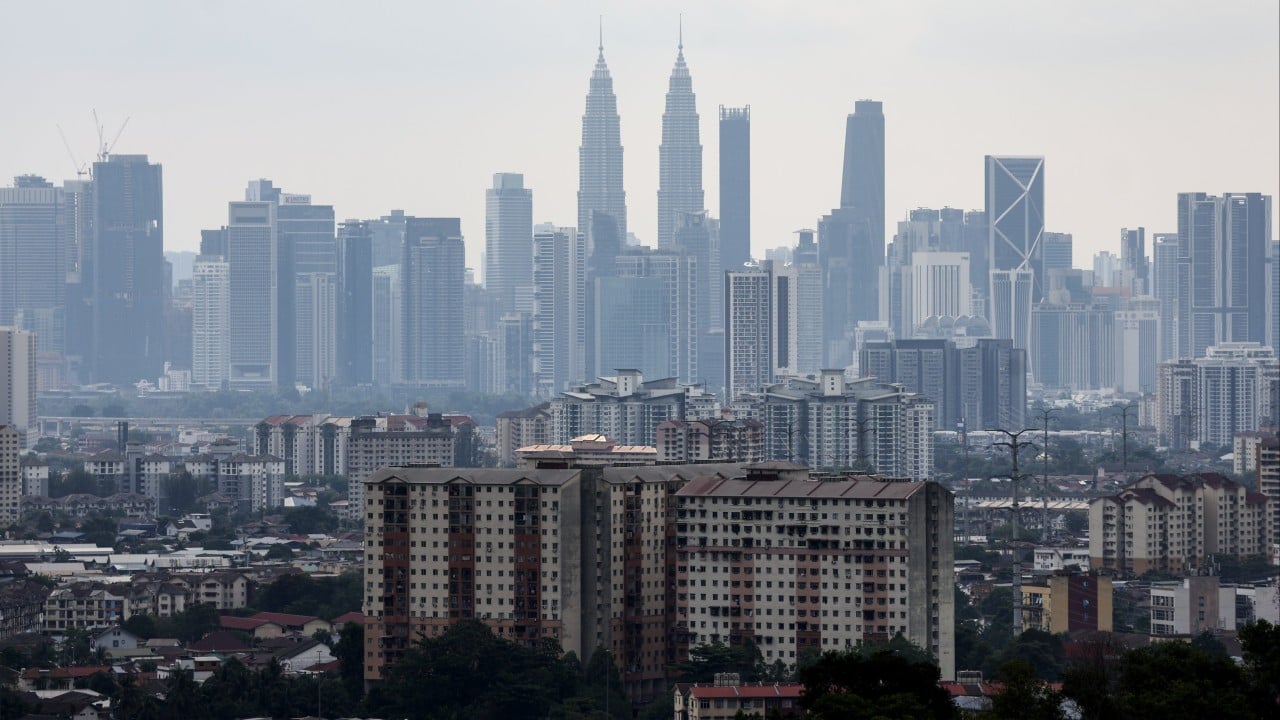
Fatima stares at the digital display of her electric stovetop. The numbers flicker, then vanish. Outside her window in suburban Petaling Jaya, the rhythmic hum of the city—a sound she has lived with for forty years—stutters into a heavy, unnatural silence. It isn't just a local fuse box or a fallen branch. Across the Malacca Strait, the world’s most vital artery has been pinched shut, and 1,500 miles away, Malaysia is beginning to starve for spark.
This is not a drill. It is the immediate, visceral reality of a nation built on a foundation of liquid gold that suddenly stopped flowing. Recently making headlines recently: Why The Strait of Hormuz Blockade Is A Massive Wake Up Call.
When news broke that the United States had initiated a blockade of the Strait of Hormuz, the initial reaction in boardrooms from New York to London was focused on the price of Brent Crude. But in the wet markets of Ipoh and the semiconductor plants of Penang, the reaction was a sharp, cold realization: Malaysia is the world’s most vulnerable middleman. We are a nation that exports electronics but imports the very lifeblood required to manufacture them.
The blockade is a geopolitical chess move, but for the average Malaysian, it is a sudden, aggressive tax on existence. Further details on this are covered by BBC News.
The Invisible Pipe
To understand why a conflict in the Middle East dictates the price of a plate of nasi lemak in Borneo, we have to look at the math of our dependence. Malaysia’s energy mix is a precarious balancing act. While we possess our own offshore oil and gas reserves, we are paradoxically reliant on imported refined petroleum and specialized fuels to keep our power plants churning and our logistics fleets moving.
Approximately 30 percent of the world’s sea-borne oil passes through the Strait of Hormuz. When the Trump administration moved to "choke the source," as the headlines put it, they weren't just targeting adversaries. They were inadvertently severing the umbilical cord of Southeast Asian industrialism.
Consider the hypothetical case of Ahmad, a logistics manager for a fleet of refrigerated trucks. He isn't a politician. He doesn't follow the intricacies of naval maneuvers in the Persian Gulf. But when the blockade began, the price of diesel at his local Petronas station didn't just rise; it was rationed. Ahmad’s trucks carry perishable medicines and fresh produce. If the trucks don't move, the insulin doesn't reach the clinics. If the insulin doesn't reach the clinics, the blockade stops being a news item and becomes a tragedy.
The Silicon Paradox
Malaysia is often called the "Silicon Valley of the East." Our factories package and test nearly 13 percent of the world’s semiconductors. It is a prideful statistic, but one that hides a terrifying fragility. High-tech manufacturing requires a level of power stability that most people take for granted. A micro-fluctuation in voltage can ruin a batch of thousand-dollar processors.
As the energy emergency deepens, the government has been forced to make impossible choices. Do you keep the lights on in the hospitals, or do you keep the power flowing to the industrial zones that keep the economy from collapsing?
The irony is thick. We are surrounded by water and sun, yet we are held hostage by an ancient fuel trapped under a desert half a world away. For years, the transition to renewables was discussed in the abstract—a noble goal for 2050, a topic for glossy brochures and "green" summits. The blockade has turned those polite suggestions into a desperate, frantic scramble.
The "Just-In-Time" supply chain model, the darling of global trade for decades, has been revealed as a dangerous hallucination. We assumed the world would always be open. We assumed the tankers would always arrive. We were wrong.
The Anatomy of a Shortage
What does an energy emergency actually look like on the ground? It starts with the "small" things.
Streetlights are turned off at midnight to conserve the grid. The air conditioning in malls—a necessity in the sweltering Malaysian humidity—is dialed back, leaving shoppers in a damp, oppressive heat. Then come the rolling blackouts. These are scheduled, surgical strikes on the power grid, designed to prevent a total systemic collapse.
But schedules are rarely followed when the pressure drops. In the residential towers of Mont Kiara, elevators get stuck between floors. In the rural kampungs, the lack of refrigeration means food waste skyrockets. It is a slow-motion unraveling of the conveniences of modern life.
The government has responded with a series of "Energy Solidarity" measures. Fuel subsidies, long a staple of Malaysian political stability, are being pushed to their absolute breaking point. The national treasury is bleeding cash to keep the price of petrol from hitting 5 Ringgit a liter, a psychological threshold that many fear would spark civil unrest.
The Human Cost of Geopolitics
We often talk about "energy security" as if it’s a series of bar charts and pie graphs. It isn't. It’s the look on a father’s face when he realizes he can’t afford the commute to work. It’s the silence of a small business owner whose shop remains dark during peak hours.
I remember talking to a shopkeeper in Melaka shortly after the first week of rationing. He told me he felt like a diver whose oxygen line had been kinked. "You don't think about the air," he said, "until you hear the hiss stop."
The blockade is a metaphor for the new world order: a place where local stability is an illusion, and global friction is the only constant. We are learning, painfully, that being a "neutral" trading partner doesn't protect you when the giants start swinging.
The Pivot in the Dark
There is a temptation to look for a villain in this story. Some point to the aggressive unilateralism of the U.S. executive branch. Others point to Malaysia’s slow adoption of nuclear or large-scale solar. But blame doesn't generate megawatts.
The emergency has forced a radical shift in the national psyche. We are seeing a grassroots explosion of "energy independence" initiatives. Households are pooling resources to install solar panels. Factories are investing in their own localized micro-grids. It is a chaotic, expensive, and necessary evolution.
This isn't about "going green" because it’s the right thing to do for the planet. It’s about "going green" because it’s the only way to ensure that a tweet from a foreign leader doesn't plunge our children into darkness.
The blockade of Hormuz has stripped away the veneer of the globalized energy market. It has shown us that our reliance on a single, volatile transit point is a form of national negligence. We are currently a country that runs on a prayer and a very long, very thin straw.
The Last Generator
Back in Petaling Jaya, Fatima lights a candle. The flame is small, orange, and steady. It is a primitive light in a world that, until yesterday, was defined by fiber optics and LED screens. She sits by the window, watching the silhouettes of cars moving slowly through the darkened streets.
The blockade will eventually end. The ships will eventually move again. The political posturing will shift to a new theater. But the memory of the silence will remain. The next time the lights come on, they won't feel quite as permanent as they did before.
We have seen the ghost of our own fragility. We have realized that the most important resource a nation can have isn't oil, or gold, or chips. It is the ability to stand on its own two feet, powered by its own sun and its own wind, beholden to no one but its own people.
The darkness is a teacher, if we are willing to listen.
Fatima blows out the candle as the first gray light of dawn hits the horizon. The sun is rising, whether the tankers come or not.