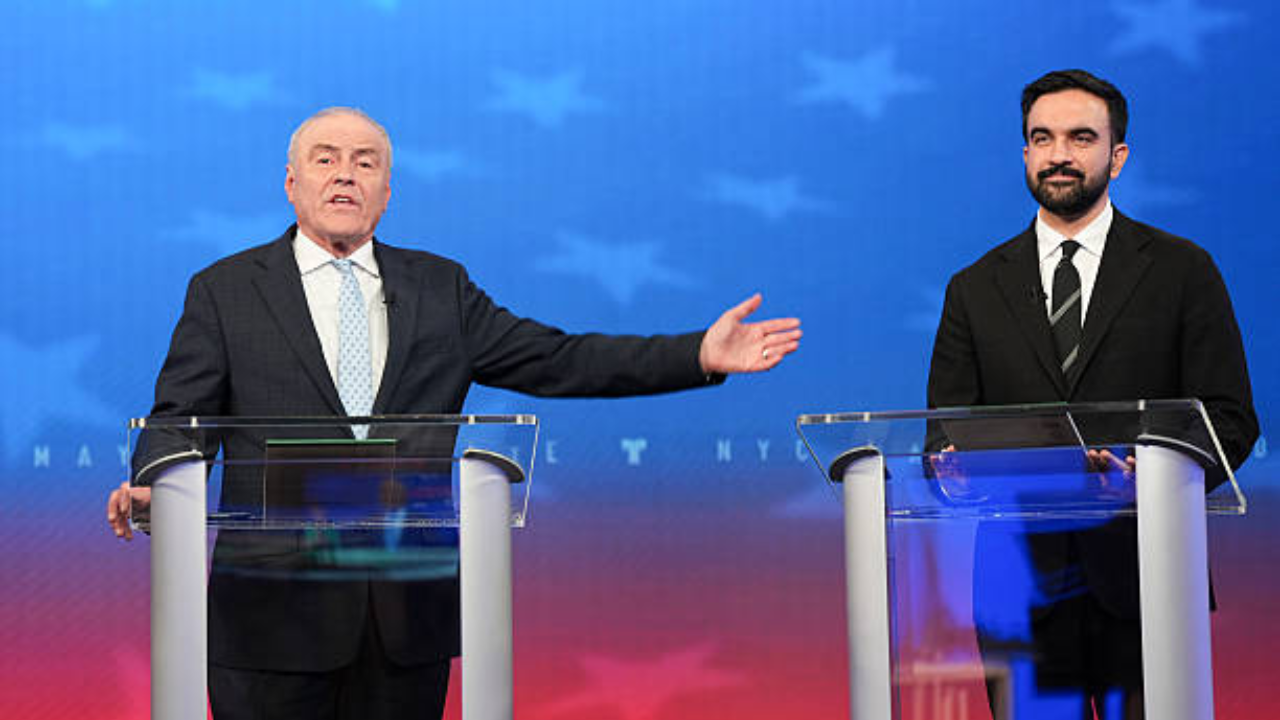
The recent collaborative media appearance between Republican perennial candidate Curtis Sliwa and Democratic Socialist Assemblyman Zohran Mamdani represents more than a local curiosity; it is a live-site case study in the breakdown of traditional ideological signaling. In a political environment defined by hyper-polarization, the decision by these two figures to engage in a high-profile comedy skit functions as a direct challenge to the Party Loyalty Coefficient, a metric that dictates the political cost of fraternizing with "the enemy." This event exposes a growing fissure in New York City’s political landscape where the utility of the traditional left-right spectrum is being outpaced by a populist-establishment axis.
The Architecture of Tactical Crossover
The Sliwa-Mamdani interaction operates on a three-pillar framework of mutual benefit that overrides standard party doctrine. By analyzing the incentives of both actors, the "backlash" mentioned in surface-level reporting reveals itself as a calculated risk-reward trade-off.
Pillar 1: The Attention Economy and Low-Cost Impressions
For a Republican candidate in a city with a 7-to-1 Democratic registration advantage, traditional advertising yields diminishing returns. Sliwa’s strategy relies on High-Variance Visibility. By partnering with an ideological polar opposite, he generates a news cycle that bypasses standard partisan filters. The cost of "backlash" from the GOP base is negligible compared to the reach gained within the demographic that usually ignores his platform.
Pillar 2: The Radical Authenticity Buffer
Mamdani, representing a district in Astoria, Queens, operates from a position of "insurgent" status within his own party. By appearing with Sliwa, he reinforces a brand of being "unbought and unbossed"—a common trope in populist rhetoric. This provides a buffer against accusations of being a typical Democratic Party operative. The skit serves as a signal to his base that his commitment to his specific brand of politics is so secure that it cannot be "contaminated" by a Republican.
Pillar 3: Common Enemy Realignment
Both figures share a structural adversary: the centrist, institutionalist wing of the New York City political machine. While their proposed solutions are diametrically opposed, their diagnosis of the status quo—inefficiency, lack of transparency, and elite capture—is identical. This creates a Tactical Convergence Zone where two outliers can collaborate to undermine the center without merging their actual policy platforms.
Quantifying the Cost of "Betrayal"
The "betrayer" label applied to Sliwa by segments of the Republican Party is a byproduct of Partisan Purity Maintenance. In political science terms, this is the mechanism by which a party prevents its members from drifting toward the center or toward "unholy alliances" that might dilute the party brand. However, the actual data on voter behavior suggests that this backlash often fails to translate into a loss of support at the ballot box for two reasons.
- Low Replacement Elasticity: In many New York districts, there is no viable alternative to the incumbent or the high-profile challenger. Voters who are offended by the skit have nowhere else to take their vote that doesn’t result in a worse outcome for their interests.
- The Satire Shield: Because the medium was a comedy skit, both actors have Plausible Deniability. Any serious policy criticism can be deflected as a lack of humor on the part of the critic, effectively delegitimizing the backlash as "out of touch."
The Mechanism of Audience Fragmentation
The traditional media model assumed a monolithic audience that would react uniformly to a political event. Today, the Sliwa-Mamdani skit is consumed through fragmented silos.
- The Hardline Base: Sees the event as a betrayal of values.
- The Disaffected Center: Sees it as a sign of "bipartisanship," even if the content is satirical.
- The Youth Demographic: Consumes the content through short-form video (TikTok/Reels), where the political context is stripped away in favor of "vibes" and entertainment value.
This fragmentation creates a De-contextualization Loop. The more the skit is shared, the less the original political identities of the actors matter, and the more their personal brands—Sliwa as the eccentric New York fixture and Mamdani as the millennial disruptor—are strengthened.
Structural Failures of Local Political Coverage
Standard reporting on this event failed to address the Incentive Structure of New York City Municipal Politics. New York's closed primary system and non-competitive general elections in most districts mean that the real battle is for "Mindshare" rather than "Vote Share."
The media’s focus on the "outrage" from certain Twitter circles is a classic example of Sentiment Over-weighting. By prioritizing the loudest voices, journalists miss the underlying data: both Sliwa and Mamdani saw a measurable spike in social media engagement, search volume, and brand mentions following the skit. In the modern political marketplace, engagement is a more valuable currency than approval ratings, particularly for those on the fringes.
The Populist Horseshoe Theory in Practice
The collaboration validates the Horseshoe Theory of Politics, which suggests that the far-left and far-right share more similarities with each other than they do with the moderate center. In this instance, the similarity is not found in policy, but in Methodology and Aesthetics.
- Methodology: Both use street-level activism and media stunts to bypass traditional gatekeepers.
- Aesthetics: Both lean into "Authentic New Yorker" personas that prioritize local color and grit over polished, consultant-driven messaging.
This alignment creates a vulnerability for the political center. If the "extremes" can successfully demonstrate that they are the only ones capable of communicating across the aisle—even through satire—they can frame the center as the true source of gridlock and division.
The Strategic Play for Political Outliers
For any political figure operating outside the establishment norm, the Sliwa-Mamdani model provides a clear blueprint for Asymmetric Brand Building.
- Identify the Mirror Image: Find an opponent who is equally disliked by the establishment but for different reasons.
- Select a Non-Political Medium: Use comedy, sports, or culture to bridge the gap. This lowers the stakes and provides an "opt-out" for supporters who are uncomfortable with the alliance.
- Target the Institutional Center: Ensure the content of the collaboration, however subtly, critiques the "system" or "the way things are done."
- Monetize the Backlash: Use the inevitable criticism from party hardliners to reinforce the image of an "independent thinker."
The backlash isn't a sign of failure; it is the final stage of the marketing funnel. It confirms that the message reached its intended target and forced the establishment to react. In the current New York ecosystem, being called a "betrayer" by party leadership is often the highest form of endorsement for a populist candidate.
The long-term risk of this strategy is the further erosion of ideological clarity. When politics becomes a performance art of "odd-couple" pairings, the underlying policy differences are obscured. This favors the candidate with the strongest personality over the one with the most rigorous policy platform. For the voter, this represents a transition from Policy-Based Choice to Narrative-Based Consumption.
Moving forward, expect an increase in these "transversal alliances." As the cost of traditional media continues to rise and its effectiveness continues to fall, the political stunt will evolve from a desperate measure into a core strategic requirement for anyone seeking to disrupt the status quo. The Sliwa-Mamdani skit was not an anomaly; it was a pilot program.