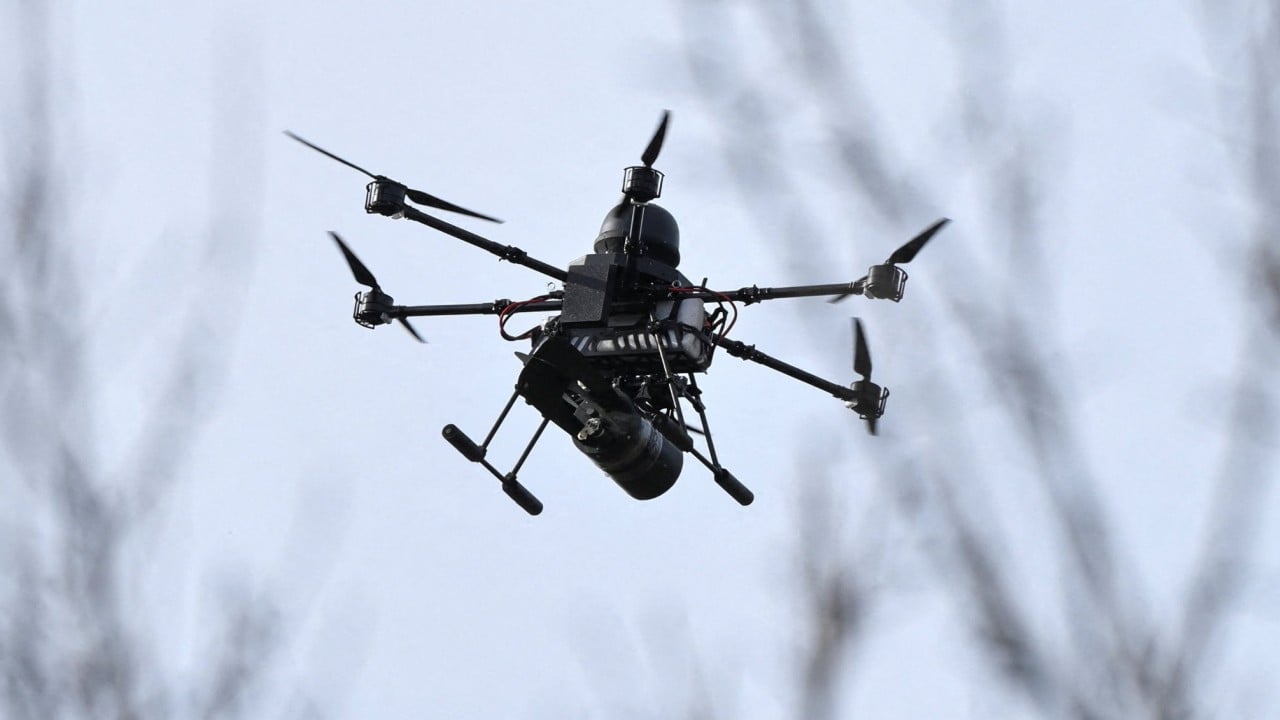
The recent alliance between a Japanese technology firm and a Ukrainian drone manufacturer has sent a clear message to Moscow. Japan is no longer a silent observer in the evolution of unmanned aerial warfare. By moving beyond humanitarian aid into the realm of dual-use hardware, Tokyo is testing the limits of its own pacifist constitution and fundamentally shifting the power dynamics in Eastern Europe. This isn't just about small-scale reconnaissance. It is about a sophisticated transfer of industrial capacity that could allow Ukraine to produce thousands of high-endurance drones far from the front lines, utilizing Japanese precision engineering to bypass the supply chain bottlenecks that currently plague the conflict.
The Kremlin’s reaction was predictable and swift, framing the move as a direct provocation. However, the anxiety in Russia isn’t merely diplomatic. It is technical. Russian air defense systems have struggled to keep pace with the sheer volume of cheap, effective loitering munitions. The introduction of Japanese-grade sensors, battery technology, and hardened navigation systems represents a massive leap in capability. If Ukraine can marry its battle-tested software with Japan’s manufacturing consistency, the resulting hardware will be harder to jam, cheaper to build, and capable of operating in weather conditions that currently ground most off-the-shelf equipment.
The Quiet Pivot of Japanese Defense Exports
For decades, Japan’s defense industry existed in a vacuum. Strict export bans meant that even the most advanced domestic technologies remained locked within the Japanese Self-Defense Forces. That wall is crumbling. The partnership with Ukraine marks a departure from the traditional "non-lethal" support—bulletproof vests and food rations—that defined Tokyo's initial response to the invasion.
This shift is driven by a realization within the Prime Minister's office. If Japan wants to remain a relevant security partner in the Pacific, it must prove that its industrial base can support a high-intensity modern war. By embedding Japanese components into Ukrainian drone frames, Tokyo is conducting a live-fire test of its industrial agility without putting boots on the ground. It is a cynical but effective way to field-test technology that might one day be needed in the East China Sea.
Why Russian Electronic Warfare Fears This Merger
Russian electronic warfare (EW) units are among the most experienced in the world. They have spent two years refining the art of GPS spoofing and frequency jamming to drop Ukrainian drones out of the sky. But Japanese electronics bring something new to the table. Most commercial drones rely on standard chips and radio modules that are easily disrupted. Japanese industrial giants specialize in custom-built, radiation-hardened, and interference-resistant circuitry.
The integration of advanced inertial navigation systems (INS) means these drones will not need a GPS signal to find their targets. They can fly "dark," calculating their position based on internal sensors rather than external satellites. When a drone doesn't need to listen for a signal, it can't be told to get lost. This renders many of Russia's most expensive EW platforms, such as the Pole-21 or the Krasukha, significantly less effective.
The Supply Chain War
Modern war is a race to the bottom of the warehouse. Ukraine consumes thousands of small drones every month. While China remains the primary source for parts, Beijing’s "neutrality" often leans toward Moscow, leading to sudden export restrictions or quality drops for Ukrainian buyers. Japan offers a reliable, high-volume alternative that isn't beholden to Chinese political whims.
Precision vs Mass
Russia has relied on quantity. By using Iranian-designed Shahed drones, they have flooded the skies with slow, noisy, but numerous targets. Ukraine’s strategy, bolstered by Japanese partnership, focuses on precision. A single drone equipped with a high-resolution thermal optic and a stabilized gimbal can do more damage than ten "dumb" munitions.
- Optics: Japanese glass and sensor arrays allow for target identification from altitudes that make the drone invisible to the naked eye.
- Motors: High-efficiency brushless motors from Japanese manufacturers provide longer flight times and quieter acoustic signatures.
- Batteries: Solid-state or high-density lithium-ion cells extend the operational radius, allowing for deep-strike missions into Russian logistics hubs.
The Constitutional Loophole
Observers often wonder how Japan, with its pacifist Article 9, can legally engage in this kind of cooperation. The answer lies in the definition of "dual-use" technology. A drone is a camera platform before it is a weapon. By framing these agreements as civilian industrial cooperation or agricultural monitoring technology, the Japanese government navigates the legal gray zones of its constitution.
However, everyone involved knows the truth. A drone that can map a field of corn with centimeter-level accuracy can also map a trench line with the same precision. This "gray zone" export strategy is the blueprint for Japan’s future as a global arms provider. It allows the country to build its defense sector without the political fallout of openly selling missiles or tanks.
Russia’s Limited Response Options
Moscow is running out of ways to pressure Tokyo. Sanctions have already been applied, and diplomatic ties are at a historic low. Beyond military posturing in the Kuril Islands or increased naval activity in the Sea of Japan, Russia has few cards left to play. This impotence is exactly what emboldened the Japanese firm to move forward with the deal.
The Kremlin's primary fear is that this is a pilot program. If Japanese-Ukrainian drone production succeeds, it could lead to similar deals involving automated ground vehicles, naval drones, and advanced AI-driven surveillance networks. The nightmare scenario for Russia is a Ukraine that doesn't just receive Western weapons, but becomes an extension of the world's most advanced industrial economies.
The Commercial Reality of War
Behind the geopolitical grandstanding lies a brutal commercial truth. The drone market is the fastest-growing sector in the global defense industry. Japanese companies, long shut out of this market, see Ukraine as the ultimate showroom. A product that survives the fields of Donbas is instantly marketable to every military in the world.
This partnership is as much about the 2030s as it is about the current conflict. Japan is positioning itself to be the premier provider of high-tech "intelligence, surveillance, and reconnaissance" (ISR) platforms. They are letting Ukraine do the dangerous work of refining the hardware in exchange for the data and the prestige of a battle-proven product.
A New Axis of Innovation
The alliance between Tokyo and Kyiv disrupts the traditional East-West divide. It creates a new axis of innovation that links the high-tech hubs of East Asia with the combat-experienced engineers of Eastern Europe. This isn't a one-way street where Japan gives and Ukraine takes. Ukrainian engineers have developed some of the most sophisticated drone-control software in existence. They are now teaching Japanese firms how to make their hardware survive in a saturated electronic environment.
This feedback loop is terrifying for Russia because it accelerates the development cycle. In traditional defense procurement, it takes a decade to develop a new aircraft. In the Ukraine-Japan partnership, the "build-test-fail-fix" cycle happens in weeks. Every time a Russian EW unit successfully downs a drone, the software is updated, the hardware is hardened, and a new version is back in the air before the end of the month.
The Silence of the Giants
Noticeably, the biggest Japanese conglomerates remain quiet about these deals. They operate through subsidiaries or smaller, specialized firms to maintain a layer of plausible deniability. This protects their massive consumer interests in other parts of the world while allowing the Japanese state to achieve its strategic goals. It is a masterclass in corporate-state coordination.
While the world watches for the next shipment of tanks or fighter jets, the real shift is happening in small crates filled with circuit boards, carbon fiber frames, and high-performance motors. These are the components of a new kind of sovereignty—one that doesn't rely on the permission of traditional superpowers.
The era of the "observer" state is over. Japan has realized that in a world of drone warfare, industrial capacity is the ultimate weapon. By shipping its technology to Ukraine, Japan isn't just helping a friend; it is declaring its intention to become an indispensable pillar of the global security architecture. Russia’s concerns are justified. They aren't just facing Ukrainian resolve anymore. They are facing the combined weight of Japanese engineering and the hard-won lessons of a nation that refuses to be conquered.
The factory floor is the new front line. Every Japanese sensor that finds its way into a Ukrainian drone represents a failure of Russian diplomacy and a victory for a new, more muscular Japanese foreign policy. The tech is already on the move. The impact will be felt in the heat of the next battery of strikes, where silence and precision will speak louder than any diplomatic protest from Moscow.
Ensure your procurement teams are looking at the sub-component level, not just the finished platforms. The real power shift is in the silicon.