A single drop of oil does not weigh much. But when twenty million barrels of it pass through a narrow, salt-crusted chokepoint every single day, that weight begins to bend the spine of global civilization. This is the reality of the Strait of Hormuz. It is a thin ribbon of blue water, barely twenty-one miles wide at its tightest grip, separating the jagged peaks of Oman from the sun-scorched coast of Iran. To a mapmaker, it is a coordinate. To a merchant sailor, it is a gauntlet. To the world's second-largest economy, it is a jugular vein.
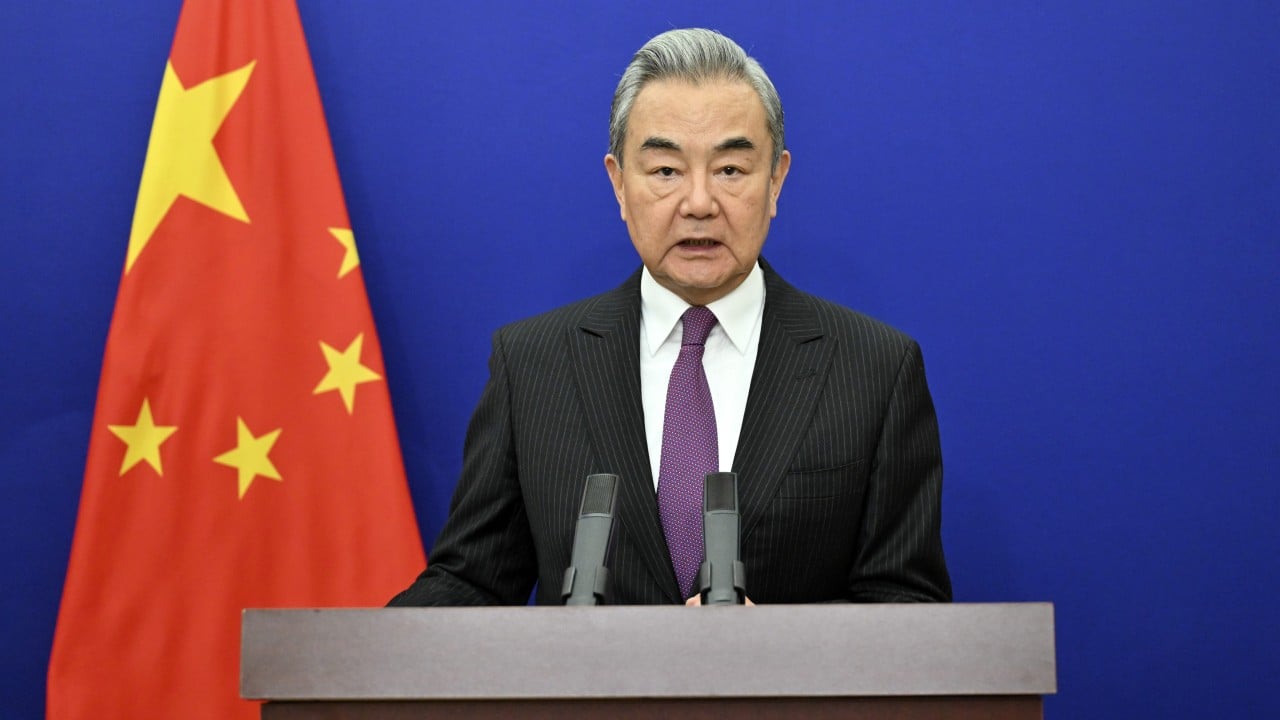
When Chinese Foreign Minister Wang Yi recently sat across from his Iranian counterparts, the conversation was dressed in the stiff, starch-collared language of diplomacy. There were mentions of "comprehensive strategic partnerships" and "mutual respect for sovereignty." Yet, beneath the polished wood tables and the steam rising from Persian tea, a much sharper anxiety pulsed. China was not just visiting a partner. It was asking for the safety of its own lifeblood.
The Ghost in the Machine
Consider a factory worker in the Guangdong province named Chen. He does not know where the Strait of Hormuz is. He likely couldn't point to it on a globe without a few minutes of searching. But his entire existence—the electricity that powers his assembly line, the plastic used in the toys he assembles, the bus that carries him home—is tethered to that narrow passage of water.
If the Strait closes, Chen’s world stops.
China imports roughly 40 percent of its crude oil from the Persian Gulf. This is not a statistic; it is a dependency. When Wang Yi calls for the "guaranteed safety of international shipping lanes," he is speaking for Chen and millions like him. He is speaking for the massive tankers, those rusting iron leviathans the size of skyscrapers, that must navigate a corridor where a single stray mine or a miscalculated drone strike can send global markets into a seizure.
The tension in the region has reached a fever pitch. In the wake of the conflict in Gaza and the subsequent Red Sea disruptions caused by Houthi rebels, the maritime world is on edge. Ships are being rerouted around the Cape of Good Hope, adding weeks to journeys and millions to fuel costs. But there is no "Plan B" for Hormuz. There is no way around it. You either pass through the needle’s eye, or you stay home.
The Weight of a Word
In the world of high-stakes geopolitics, what is left unsaid is often louder than what is shouted. Wang Yi’s public nudge to Iran was uncharacteristically direct. Usually, Beijing prefers the shadows, moving with a quiet, glacial persistence. But the current climate has forced their hand.
China has spent decades building a reputation as the "non-interfering" superpower. They don't lecture; they trade. They don't bomb; they build. Yet, this neutral stance is being tested by the chaos of the Middle East. Iran is a critical node in China’s Belt and Road Initiative, a massive web of infrastructure meant to recreate the Silk Road for the modern age. But a road is useless if it leads to a locked gate.
The Strait of Hormuz is that gate.
Iran holds the keys. By calling on Tehran to ensure "freedom and safe passage," Wang Yi was reminding his allies that friendship has a price. That price is stability. China is essentially telling Iran that while they support Tehran’s right to regional influence, that influence cannot come at the expense of Beijing’s economic heart. It is a delicate dance. One partner is trying to maintain a revolution; the other is trying to maintain a growth rate.
Steel and Saltwater
To understand the physical reality of this threat, you have to look at the water. Navigation in the Strait is not a simple matter of pointing a ship forward. The shipping lanes are narrow—two miles wide in each direction, separated by a two-mile buffer zone. It is a high-speed highway where the vehicles are 300,000-ton monsters that take miles to come to a full stop.
Imagine being the captain of the Lian Hua Hu, a Chinese supertanker. You are carrying two million barrels of crude. To your left, the Iranian Revolutionary Guard patrols in fast-attack boats, small and lethal. To your right, the mountains of the Musandam Peninsula loom like teeth. You are operating in a space where "freedom of navigation" isn't a legal theory; it's the difference between a successful delivery and a global catastrophe.
If Iran were to follow through on its occasional threats to block the Strait, the price of oil wouldn't just rise. It would skyrocket. We are talking about $150, even $200 a barrel. The ripple effect would be instantaneous. The price of bread in Cairo would go up. The cost of shipping a container from Shanghai to Los Angeles would double. The fragile recovery of the post-pandemic global economy would shatter like dropped glass.
The Invisible Stakes
Why does this matter now more than ever? Because the old rules of the sea are dissolving. For decades, the United States Navy acted as the de facto guarantor of the Strait. They were the sheriff in town, keeping the lanes open through sheer presence. But the U.S. is looking elsewhere now, shifting its gaze toward the Pacific.
China finds itself in an uncomfortable position. It wants the U.S. out of its backyard, but it still relies on the "U.S. security umbrella" to protect its oil interests in the Middle East. Wang Yi’s statement is a signal that China realizes it may have to start doing its own heavy lifting. It is stepping into the role of a mediator, trying to use its economic leverage over Iran to do what American warships once did through intimidation.
But leverage is a fickle thing. Iran is a nation that has survived decades of sanctions and isolation. They are masters of the "calculated risk." They know that China needs them, but they also know that they need China. It is a marriage of convenience where both parties are sleeping with one eye open.
The "human-centric" narrative here isn't just about the diplomats in the room or the sailors on the ships. It’s about the vulnerability of our modern lives. We live in an era of terrifyingly efficient logistics. We expect the shelves to be full. We expect the lights to turn on. We expect the world to be "seamless," a word so often used it has lost its meaning.
But the world is not seamless. It is stitched together with steel cables and shipping routes that pass through some of the most volatile geography on Earth. Our comfort is a fragile thing, built on the assumption that everyone will play by the rules of the sea.
The Long Shadow
As Wang Yi leaves Tehran, the tankers continue to move. They move under the blistering sun of the Gulf, their hulls stained with salt and rust, carrying the energy that keeps the world spinning. The diplomats have had their say. The communiqués have been filed. The "comprehensive strategic partnership" remains intact, at least on paper.
Yet, the tension remains. It sits in the chest of every merchant mariner entering the Gulf of Oman. It resides in the spreadsheets of energy analysts in Beijing who watch the tracking data of every vessel with the intensity of a surgeon watching a heart monitor.
The Strait of Hormuz is a reminder that for all our digital sophistication and our "cloud-based" lives, we are still tied to the physical. We are still a species that depends on narrow passages and the goodwill of neighbors who may not like each other.
The water in the Strait is deep and dark. It hides mines, it hides submarines, and it hides the secrets of nations. China has made its move, not with a fleet of ships, but with a series of pointed words. They are betting that the logic of the marketplace will outweigh the logic of the sword.
But out there, where the desert wind meets the sea, logic is often the first thing to drown. The world watches the horizon, waiting to see if the next tanker emerges safely from the haze, or if the pulse of the Persian Gulf finally begins to skip a beat.