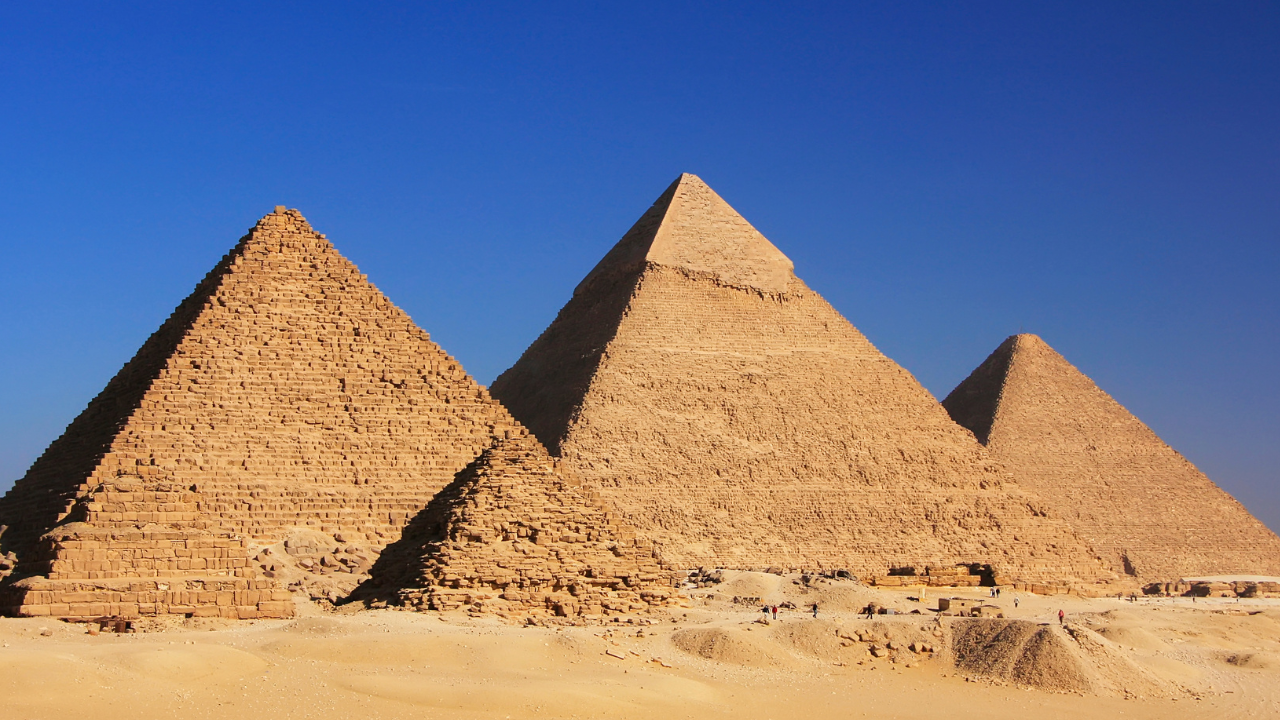
Archaeologists love a good struggle. They look at the Great Pyramid of Giza and see a 20-year grind of sweat, ropes, and primitive stubbornness. The standard narrative claims that tens of thousands of workers spent decades hauling 2.3 million limestone blocks into a heap just because a Pharaoh said so. It’s a story of "how" that completely ignores the "why" and the "who."
Stop looking at the pyramids as a construction project. Start looking at them as a masterclass in hydraulic engineering and logistics that makes our modern infrastructure look like a middle school science fair. The mainstream obsession with the sheer number of stones is a distraction. If you want to understand Giza, you have to stop thinking about muscles and start thinking about fluid dynamics.
The Ramp Fallacy
Every textbook features a drawing of a massive, straight-line ramp stretching into the desert. It’s a geometric nightmare. To reach the top of the Great Pyramid at a grade manageable for humans pulling multi-ton blocks, a ramp would need to be a mile long. It would require as much material as the pyramid itself.
Logistically, this is a failure. No project manager in the history of the world would build two pyramids just to finish one. Some suggest internal ramps or spiral inclines, but these create a bottleneck. You can't fit enough men on a narrow internal ledge to move a 70-ton granite slab into the King’s Chamber.
The industry consensus is stuck on friction. They assume the Egyptians fought gravity with rope. They didn't. They bypassed it.
Water Is the Forgotten Engine
The Giza plateau isn't just a graveyard; it's a massive, dry machine. Recent geological surveys and satellite imagery have identified the "Ahramat Branch," a long-lost arm of the Nile that once flowed directly past the pyramid sites. This wasn't a convenience for thirsty workers. It was the primary power source.
The Egyptians were the masters of the "Hydraulic Lift."
Imagine a series of watertight shafts and canals. By using basic buoyancy and water pressure, you don't "pull" a stone; you float it. A block of limestone weighs roughly $2.5$ grams per cubic centimeter. In water, that effective weight drops significantly. With the right bladder system—think goatskin air bags—a stone becomes a boat.
Archaeologists often point to the lack of "complex machines" like pulleys as proof of primitive methods. They are looking for wheels when they should be looking for plumbing. The "Checkered Floors" found in certain temple areas aren't decorative. They are leveled surfaces designed for water-based transport. When you have a river at your doorstep and a deep understanding of hydrostatic pressure, why would you waste 20,000 men on a rope?
The 20-Year Timeline Is a Mathematical Joke
We are told the pyramid was built in roughly 20 years. Let’s do the math that the "brute force" crowd avoids.
To place 2.3 million blocks in 20 years, working 10 hours a day, 365 days a year, you have to set a block every two minutes.
Every. Two. Minutes.
That includes quarrying, shaping, transporting, and the precision fitting of casing stones that are joined to within 1/50th of an inch. If you try to do that with 40,000 guys and a ramp, you have a traffic jam that ends in a massacre. The site isn't big enough for that many people to move effectively.
The only way to hit that speed is through modular, parallel processing. The Egyptians weren't a workforce; they were an assembly line. They didn't build a pyramid; they manufactured one. They likely pre-cut stones at the quarry to specific templates, meaning the pyramid was "assembled" rather than "constructed."
The Precision Insult
We are obsessed with the "how" of the weight, but we ignore the "how" of the alignment. The Great Pyramid is aligned to True North within three-sixtieths of a degree. This isn't just "good for the time." It’s better than the Meridian Building at the Greenwich Observatory in London.
You don't get that level of accuracy with a "get more guys to pull harder" mentality. That requires high-level optical surveying. It suggests the use of the "circumpolar star" method, where surveyors tracked the path of a star and bisected the angle.
The mainstream narrative treats these people like lucky primitives. It’s a subtle form of chronological snobbery. We assume that because they didn't have internal combustion, they didn't have "technology." In reality, they had a more sophisticated understanding of the natural world than we do. They used the earth’s rotation and the Nile’s energy as their primary tools.
The Labor Force Was an Elite Guild, Not Slaves
Hollywood loves the image of the whip-cracking overseer and the starving slave. It’s a lie.
Excavations of the workers' village show they ate prime beef, had access to medical care (including brain surgery that patients survived), and were organized into "phyles" or gangs with names like "The Friends of Khufu."
This was a national service project. It was the world's first massive economic stimulus package. During the Inundation—the months when the Nile flooded and farming was impossible—the entire population was mobilized. But they weren't mindless drones. They were highly skilled artisans and engineers.
The "contrarian" truth? The Great Pyramid wasn't a tomb that bankrupted the country. It was a vocational school that unified the nation. It taught a disparate group of tribes how to work as a singular, mechanized unit. The pyramid was the byproduct of a social engineering project, not the sole goal.
The Casing Stone Secret
When you see the pyramid today, you see a jagged, brown mountain. That’s a carcass.
Originally, it was covered in 115,000 highly polished Tura limestone casing stones. They were bright white. On a sunny day, the pyramid would have been visible from miles away, glowing like a literal star on earth.
These stones weren't just "slapped on." They were cut with such precision that you can't slide a razor blade between them. This is the part where the "heaving ropes" theory completely falls apart. You cannot achieve that level of tolerance using brute force. It requires a level of stability and control that only comes from sophisticated leveling tools and, likely, water-leveling the entire base of the plateau—a process that involves cutting a grid of channels into the bedrock and filling them with water to find a perfect horizontal plane.
Why We Refuse to See the Truth
Admitting the Egyptians used sophisticated fluid dynamics and advanced geometry to build the pyramids means admitting our own trajectory isn't the only way to "progress."
We like the "ramps and ropes" story because it makes us feel superior. It fits our narrative that humanity is on a linear path from "stupid" to "smart." If the Egyptians could move 70-ton lintels using water pressure and celestial alignment with more precision than we can today, it suggests we’ve lost as much knowledge as we’ve gained.
We have spent 200 years looking for the "lost tools" of the pyramid builders. We think they must have had diamond saws or alien tech. They didn't. Their tool was the Earth itself. They used the river, the stars, and the physics of the planet as a giant lever.
Stop looking for the ramp. Look for the water.
Build a better mental model. The Great Pyramid isn't a tomb; it’s a monument to a civilization that understood the environment better than we ever will. If we tried to build it today with our "modern machines," we’d likely go over budget, miss the deadline, and still get the alignment wrong.
The Egyptians didn't work harder. They worked with the grain of the universe.
Stop asking how they moved the stones. Ask why you think they needed a machine to do what nature already does for free.