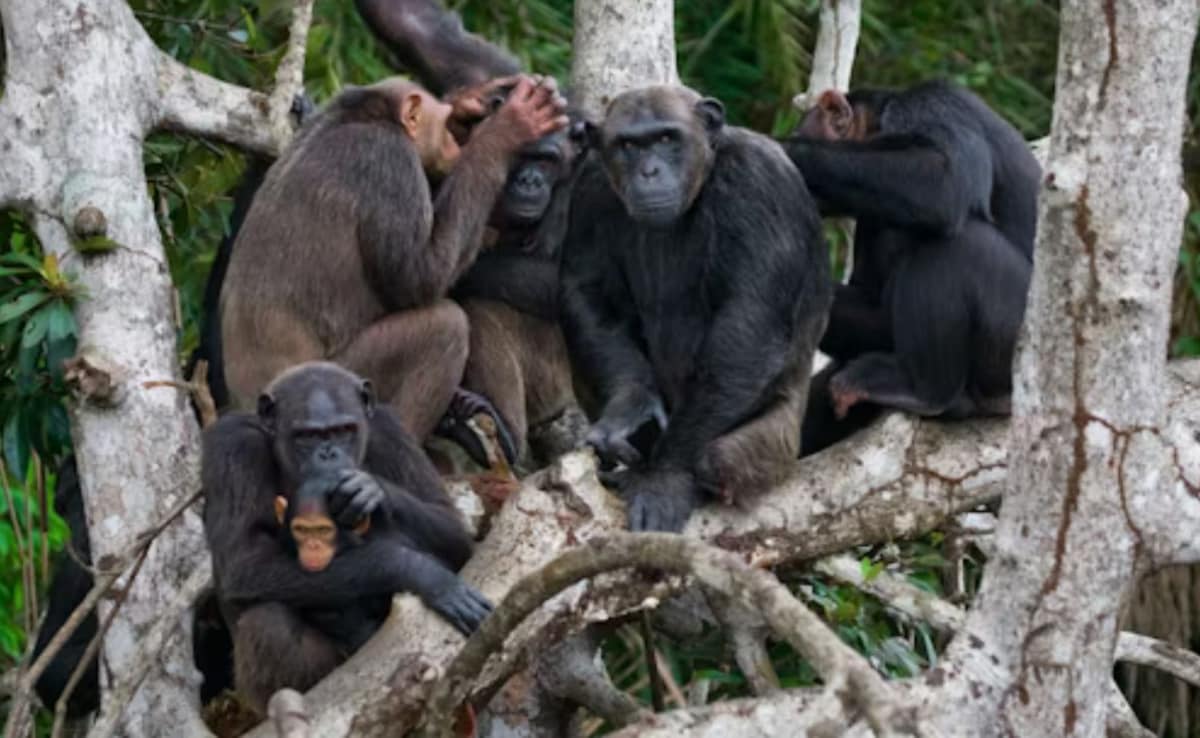
The outbreak of intra-species lethal violence among the Ngogo chimpanzee community in Uganda’s Kibale National Park represents more than a biological anomaly; it is a breakdown of social cohesion driven by resource competition and demographic saturation. While public discourse often frames these events through the lens of human-like "civil war," a rigorous analysis reveals a calculated, albeit instinctive, expansionist strategy. The conflict hinges on the Territorial Integrity Variable, where a group’s survival is directly indexed to its ability to monopolize high-quality forage areas and reproductive access.
The Structural Drivers of Primatological Warfare
Chimpanzee societies operate under a fission-fusion social structure. Unlike rigid hierarchies, this model allows for fluid group sizes that fluctuate based on food availability. However, when a population reaches a critical density—as seen in the Ngogo community, which grew to over 200 individuals—the fission-fusion model undergoes a systemic failure. The group can no longer maintain a unified social identity, leading to the emergence of distinct sub-factions.
Three primary variables dictate the transition from social tension to lethal aggression:
- The Coalition Threshold: For a splinter group to initiate violence, it must achieve a local numerical advantage of at least 3-to-1. Research into chimpanzee raiding parties indicates that males rarely engage in lethal combat unless they can isolate a single victim from the opposing faction, minimizing the risk of self-injury.
- Resource Scarcity Pressures: In Kibale, the distribution of Ficus (fig) trees acts as the primary economic driver. If the carrying capacity of the shared territory drops below the nutritional requirements of the total population, the "tax" of maintaining a large, unified group outweighs the benefits of collective defense.
- Male Philopatry and Kinship Bonds: Because males remain in their natal groups while females emigrate, the internal social fabric is built on fraternal alliances. When these alliances split along lineage lines, the resulting "civil war" is essentially a competition between rival genetic coalitions for the right to pass on their traits.
The Mechanics of the Lethal Raid
The violence observed in Ugandan chimpanzee groups is not chaotic. It follows a distinct Tactical Sequence designed to attrit the opposing force while preserving the aggressor's "capital" (breeding-age males).
Phase 1: Border Reconnaissance and Silent Patrols
Patrolling is a high-cost activity. Males move in single file, suppressing their usual vocalizations. This phase serves as an intelligence-gathering mission to assess the strength of the rival faction’s perimeter.
Phase 2: The Isolation Maneuver
A successful strike relies on the Isolation Principle. Chimpanzees do not engage in "pitched battles" in open clearings. Instead, they wait for a member of the rival group to forage alone or in a small sub-party.
Phase 3: Total Incapacitation
Once a target is isolated, the aggressors employ a specific set of lethal techniques:
- Disarticulation of limbs.
- Targeting of the throat and groin.
- Internal organ trauma via blunt force.
This is not "predatory" behavior; the victims are rarely consumed in their entirety. It is demographic engineering. By removing fertile males and infants from the rival group, the aggressors effectively "bankrupt" the opposing faction's future reproductive potential.
Territorial Expansion as a Return on Investment
The "war" in Kibale resulted in the larger Ngogo faction seizing a significant portion of territory previously held by their rivals. From a consultant's perspective, this is a Territory-for-Protein Trade-off.
The energy expended on patrols and raids is an investment. The "return" is access to new groves of fruiting trees and a buffer zone that reduces the frequency of surprise attacks from outside groups. Data from long-term studies at Gombe and Kibale show that groups that successfully expand their territory see a measurable increase in the body mass and reproductive success of their females.
The correlation is direct: More Land = Higher Nutritional Flux = Shorter Inter-birth Intervals.
The Role of Infanticide in Factional Warfare
A harrowing but logical component of these conflicts is the targeted killing of infants. In the context of a group schism, infanticide serves two strategic purposes:
- Genetic Erasure: Eliminating the offspring of the rival faction ensures that the rival's genetic line does not persist in the newly conquered territory.
- Female Recruitment: By killing a female's infant, the aggressors force her back into estrus. This creates a window for the dominant males of the winning faction to sire their own offspring with the captured or "annexed" female.
This behavior highlights the brutal efficiency of the Darwinian Cost-Benefit Analysis. The chimpanzee does not act out of "hatred" in the human sense, but out of a biological imperative to maximize the survival of its specific sub-group at the absolute expense of the other.
Ecological Instability and the Risk of Total Collapse
While territorial expansion provides short-term gains, the transition from a single large community to two warring factions creates a state of Ecological Fragility.
Constant warfare shifts the group's energy budget. Time spent on border defense is time stolen from foraging and grooming—the latter being the primary mechanism for maintaining internal social stability. If the conflict persists too long without a clear victor, both factions may suffer from chronic stress, leading to suppressed immune systems and vulnerability to respiratory outbreaks, which are common in Ugandan chimpanzee populations.
The "winner" of a chimpanzee civil war is often the group that can maintain the highest degree of Internal Cohesion while externalizing violence. If the splintering continues into a third or fourth sub-faction, the original community ceases to be a dominant regional power and becomes a collection of vulnerable, competing units.
Strategic Forecast: The Future of the Ngogo Schism
The current trajectory in Kibale suggests that the larger Ngogo faction will continue its policy of aggressive annexation until the smaller faction is either completely absorbed or driven into marginal, low-resource habitats.
Conservationists and researchers must monitor the Inter-Group Interaction Frequency (IGIF). A high IGIF indicates that the border zones are still in flux. Once the IGIF drops, it signals that a new "market equilibrium" has been reached—the borders have been redrawn, and the cost of further expansion has finally exceeded the caloric rewards of the new territory.
Observers should expect a period of "hyper-aggression" followed by a sharp decline in violence as the winning faction pivots from Expansionary War to Consolidation and Maintenance. The long-term survival of the Kibale chimpanzees depends on this pivot; if the groups cannot transition back to a state of relative stability, the demographic loss from internal conflict will eventually outweigh the natural birth rate, leading to a permanent population decline.
The ultimate lesson of the Ugandan chimpanzee war is that social complexity has a ceiling. When a group outgrows its ability to manage internal "contracts," the system resets through the most primitive mechanism available: the violent redrawing of the map.