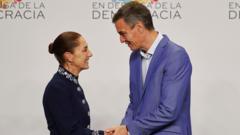
Claudia Sheinbaum stands at a podium, the weight of a thousand-year history pressing against the modern glass and steel of Mexico City. To a casual observer in Madrid or Washington, the headlines look like a standard bureaucratic spat. They see a "row" over an uninvited king. They see a "diplomatic friction." But to understand why the President of Mexico is willing to risk a rift with one of her country’s largest trading partners, you have to look past the ink on the treaties and into the soil itself.
The dispute is simple on the surface. King Felipe VI of Spain was not invited to Sheinbaum’s inauguration. In response, Spain sent no one. The Spanish government called the exclusion "unacceptable." Sheinbaum, calm and unyielding, insists there is no "crisis." She calls it a matter of dignity. Learn more on a similar subject: this related article.
To the bankers in Madrid, this feels like an unnecessary provocation. To a woman living in a small village in Oaxaca, whose language was nearly erased by three centuries of colonial rule, it feels like the first time someone is finally telling the truth out loud.
The Letter That Never Arrived
The friction didn't start with Sheinbaum. It started with a letter sent in 2019 by her predecessor, Andrés Manuel López Obrador. He asked the Spanish Crown for a simple gesture: an apology for the abuses committed during the Conquest. Additional journalism by NBC News delves into comparable perspectives on the subject.
Spain didn't just say no. They essentially ignored it.
Imagine you are at a dinner party. Someone accidentally breaks a precious family heirloom you’ve kept for generations. You don't ask for money; you just ask them to acknowledge they broke it. Instead, they turn their head, look at the wall, and ask someone else to pass the salt. That silence is what Sheinbaum is reacting to today. It isn't about "hating" Spain. It is about the refusal of a former colonial power to look its own history in the eye.
The Spanish Ministry of Foreign Affairs views the Conquest as a shared heritage, a bridge built between two worlds. Mexico’s current leadership views it as a crime scene that was never taped off. When Sheinbaum says there is no "diplomatic crisis," she is using the language of a head of state to mask a much deeper, more personal conviction. She is signaling that the era of Mexico seeking validation from its "Mother Country" is over.
The Invisible Stakeholders
Consider a hypothetical student in Madrid named Alejandro. He grows up learning about the bravery of Hernán Cortés and the "civilizing mission" of the Spanish Empire. To him, the King is a symbol of stability and modern democracy. When he hears that his King was snubbed, he feels insulted. He sees it as radical populism.
Now, consider Maria, a real-world descendant of the Nahua people. For Maria, the "civilizing mission" involved the systematic destruction of her ancestors' records, the forced conversion of their souls, and the extraction of gold that built the very palaces Alejandro admires in Madrid. When Maria sees Sheinbaum stand her ground, she doesn't see a "diplomatic row." She sees a daughter of Mexico refusing to curtsy to a ghost.
These two people are looking at the same event through different ends of a telescope. Sheinbaum’s task is to navigate the space between them.
The economic ties are massive. Spain is Mexico’s second-largest foreign investor. Billions of dollars flow between the two nations through banks like BBVA and Santander. Power companies like Iberdrola have deep roots in Mexican infrastructure. On paper, it is a marriage of necessity. In reality, it is a marriage where one partner is tired of the other pretending the pre-nuptial agreement didn't involve a heist.
Beyond the Handshake
Diplomacy is often a theater of the polite. We expect leaders to smile, shake hands, and bury the past under a layer of fresh carnations. Sheinbaum is breaking the script. By excluding the King but inviting the Spanish Prime Minister—who ultimately declined to attend in solidarity with the Crown—she drew a sharp line between the Spanish people and the Spanish monarchy.
It was a surgical strike.
Sheinbaum is a scientist by training. She approaches problems with a cold, analytical eye. She knows that Mexico cannot afford a total break with Spain. But she also knows that a nation's psyche cannot heal if it continues to accept a narrative that diminishes its own trauma.
"When you don't respond to a letter," Sheinbaum told a room full of reporters, "you're not just ignoring a president. You're ignoring a people."
The "crisis" isn't about who sits in which chair at an inauguration. It’s about the fact that the modern world is still built on the foundations of the old one. We like to think we live in a post-colonial era, but the architecture of our global economy says otherwise. The gold is still in the European vaults. The languages of the conquered are still secondary to the languages of the conquerors.
The Weight of the Crown
Spain’s refusal to apologize is rooted in a fear of the "Black Legend"—the historical narrative that depicts the Spanish Empire as uniquely cruel. They worry that one apology will lead to a floodgate of reparations claims and a tarnished national brand. They want to move forward.
But you cannot move forward if your feet are still stuck in the mud of the past.
Sheinbaum’s gamble is that Mexico is now strong enough to set the terms of its own relationships. She is betting that the "diplomatic friction" is a small price to pay for a solidified national identity. She is speaking to the millions of Mexicans who feel that their history has been treated as a footnote to European glory.
History is not a stagnant thing. It breathes. It moves. It hides in the way a border is drawn or the way a diplomat chooses his words.
The room in the National Palace is quiet now, the inauguration over, the guests gone. The King stayed in Madrid. The President stayed in Mexico City. The "crisis" that wasn't a crisis remains a simmering tension, a reminder that some wounds are too deep for a simple handshake to fix.
Sheinbaum is not looking for a fight. She is looking for an ending to a story that began five centuries ago. She is waiting for a letter that may never come, standing in the doorway of a house that her ancestors built, even if they weren't the ones who got to keep the keys.
The sun sets over the Zócalo, casting long, jagged shadows across the ancient stones. The ghosts of the past are still there, whispering in the wind that whips through the square. They aren't asking for revenge anymore. They are just asking to be seen. And for the first time in a very long time, the person standing at the podium is looking right back at them.