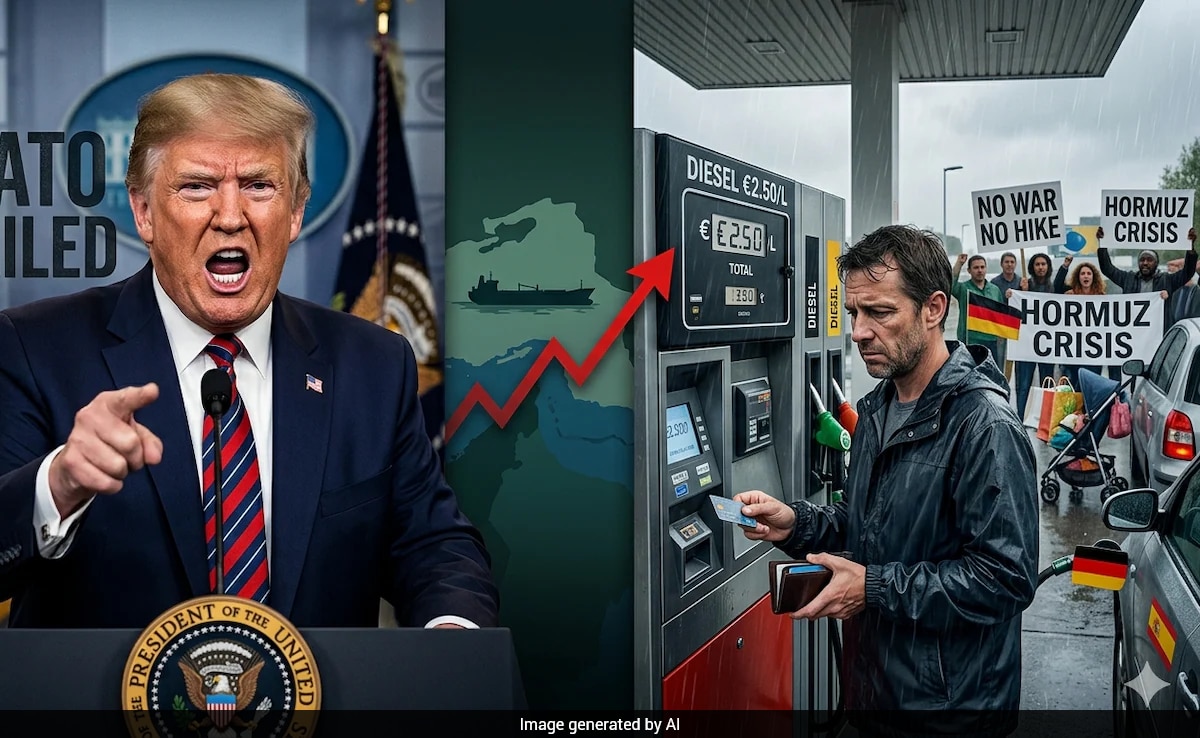
The honeymoon between Washington and Brussels didn't just end; it evaporated the moment diesel prices at European pumps began their vertical climb. While President Trump frames the recent strikes on Iran as a necessary move for global security, the view from the streets of Paris, Madrid, and Rome is far more cynical. To the average European voter, this isn't a "war for freedom"—it's a war they can't afford to pay for.
You're seeing a massive, uncoordinated, yet undeniable pivot. European leaders who were previously content to issue mild statements of concern are now moving into active diplomatic resistance. They aren't doing it because they've suddenly developed an affinity for Tehran. They're doing it because their economies are staring down the barrel of a double-digit inflation comeback that makes the 2022 energy crisis look like a warm-up act.
The Brutal Math of the Strait of Hormuz
Geopolitics is often just accounting with higher stakes. About 20% of the world's liquefied natural gas (LNG) and nearly 30% of its oil move through the Strait of Hormuz. When Trump’s administration ramped up military pressure, the "war premium" on Brent crude didn't just nudge upward—it exploded.
European gas prices recently surged by 70% in a single month. For a continent that has spent the last three years trying to wean itself off Russian energy, this is a nightmare scenario. We're talking about a €14 billion increase in the EU’s fossil fuel import bill in just 30 days. That’s money being sucked directly out of the European economy and into a geopolitical firestorm they didn't start.
Spain’s Prime Minister Pedro Sánchez was the first to blink, flatly refusing to let U.S. forces use Spanish bases for operations against Iran. He’s not alone. Even Italy, usually a reliable partner for Washington, has voiced "legal concerns" that are really just thinly veiled panic over shipping costs.
Why Washington and Brussels See Different Maps
The U.S. has a luxury Europe doesn't: energy independence. Thanks to the Permian Basin and domestic shale, the American economy can absorb a global price spike with significantly less trauma. In fact, some U.S. energy producers are making a killing.
Europe has no such buffer.
- The Diesel Deficit: Europe has a structural shortage of diesel, essential for its trucking and logistics sectors.
- The Russian Ghost: Previous sanctions on Russian crude mean Europe is already working with a restricted supply chain.
- Storage Scares: Europe entered 2026 with gas storage levels significantly lower than in previous years—roughly 46 billion cubic meters compared to 77 billion in 2024.
When you're running low on fuel and your supplier starts a fight with the neighbor who owns the gas station, you don't cheer. You look for a new supplier or a way to stop the fight. That’s exactly what’s happening in Brussels right now.
The Fracturing of the Western Front
It’s a mistake to think Europe is a monolith on this. The "Fury" isn't evenly distributed, which creates a dangerous internal friction for the EU.
Germany’s Chancellor Friedrich Merz has tried to play the role of the bridge-builder, visiting the White House to signal alignment. But even he had to keep quiet when Trump publicly berated other European allies. Why? Because the German industrial heartland—companies like BASF and Volkswagen—cannot survive another sustained energy price peak without massive state subsidies they no longer have the budget to provide.
Then there’s Poland and the Baltics. They’re still backing the U.S. hard, viewing Iran through the lens of its military cooperation with Russia. This creates a "New Europe" vs. "Old Europe" split that hasn't been this deep since the 2003 invasion of Iraq.
The Pakistani Mediation and the Two-Week Window
The recent announcement of a two-week ceasefire, brokered partially by Pakistan, isn't just a lull in the fighting. It’s a desperate attempt to let the global markets breathe. Trump claimed he’s negotiating on behalf of Mideast Gulf neighbors, but the real pressure came from the quiet, frantic phone calls from European capitals.
European gas prices plunged the moment the ceasefire was announced. That market reaction tells you everything you need to know. The "fury" isn't just about the war; it's about the volatility. Businesses can handle high prices if they’re predictable. They can’t handle a 20% swing every time a drone crosses a border.
What Happens Next
The "War on Iran" is quickly becoming a "War on European Competitiveness." If this conflict enters a prolonged phase, expect to see the following shifts in European policy:
- Aggressive Strategic Autonomy: Watch for the EU to accelerate its own diplomatic channels with Tehran, bypassing the State Department entirely.
- Renewed "Green" Desperation: The transition to renewables will no longer be framed as an environmental goal, but as a hard-line national security requirement to escape U.S. geopolitical whims.
- Sanctions Friction: Europe may begin quietly loosening its own secondary sanctions or refusing to enforce new U.S.-led restrictions to keep some level of energy flowing.
If you're tracking this, don't look at the military maps. Look at the Brent Crude ticker and the price of a liter of petrol in Berlin. That’s where the real war is being won or lost. Europe is tired of being the "collateral damage" in a Washington strategy that seems to ignore the reality of a globalized, fragile energy market. The next few months won't be about shared values; they'll be about survival.