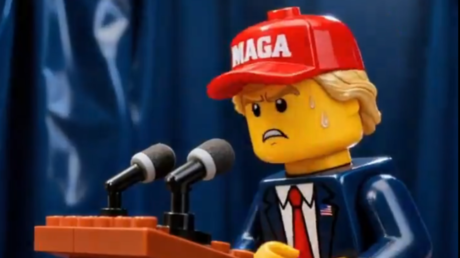
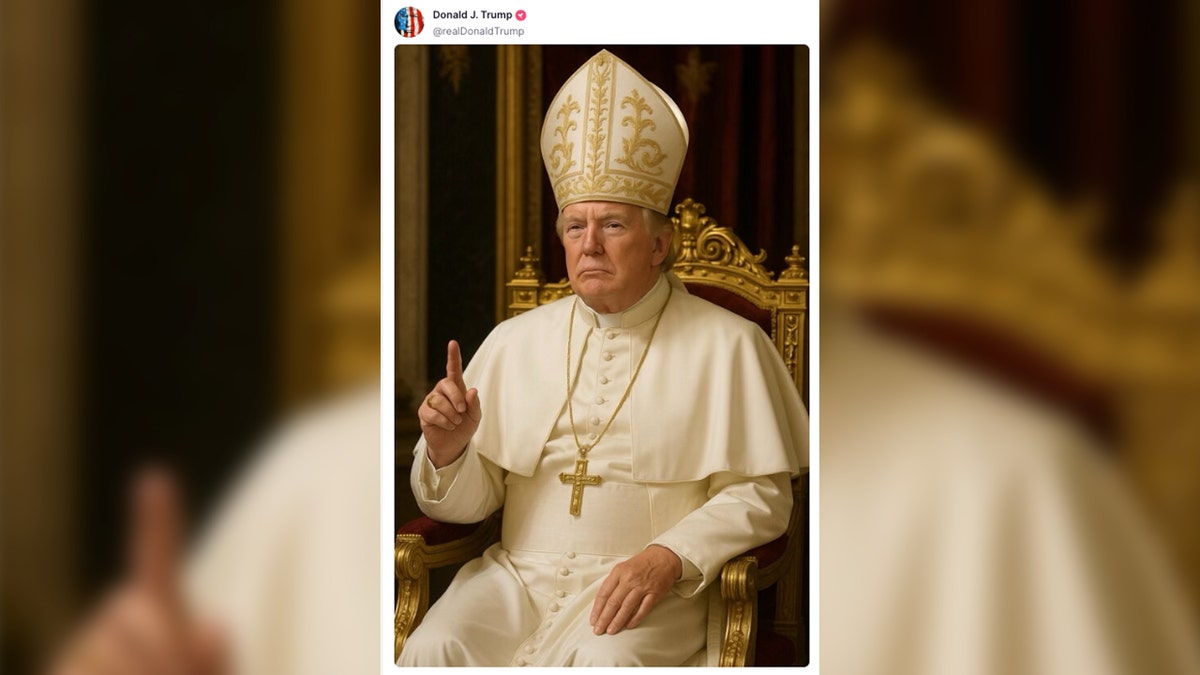
The removal of a social media post by a high-profile political figure is rarely an act of spontaneous regret; it is a calculated response to a shift in the cost-benefit ratio of the underlying asset. When Donald Trump shared, then deleted, an image depicting himself in a messianic context alongside Jesus Christ, he engaged in a specific form of identity-based brand signaling. The subsequent deletion represents a tactical pivot necessitated by the realization that the post's "outrage coefficient" had surpassed its "engagement utility." To understand this maneuver, one must examine the mechanics of religious syncretism in modern political marketing and the structural constraints of digital audience retention.
The Cognitive Framework of Messianic Branding
Political communication relies on the activation of pre-existing schemas in the voter's mind. By leveraging religious iconography, a candidate attempts to bypass rational policy discourse and tap into deep-seated moral foundations. This specific instance utilizes three distinct psychological levers: For a more detailed analysis into this area, we suggest: this related article.
- Divine Mandate Validation: Positioning a political actor as a chosen vessel to neutralize the perceived "secular threat" from opposing factions.
- In-Group Moral Superiority: Strengthening the bond with a specific demographic (white evangelical voters) by adopting their primary cultural symbols.
- The Persecution Narrative: Aligning the candidate's legal and political challenges with the historical suffering of religious figures, thereby framing every setback as a spiritual trial rather than a procedural reality.
The failure of the "Jesus image" post lies in its breach of the Sacred-Profane Boundary. While supporters often tolerate metaphorical comparisons, the literal visual juxtaposition of a contemporary politician with a deity risks triggering the "backfire effect" among moderate believers who view such imagery as sacrilegious. This creates a liquidity trap for the brand: the post attracts attention but loses institutional credibility.
Quantitative Drivers of Post Deletion
The decision to delete digital content in a high-stakes campaign environment is governed by real-time data feedback loops. Analysts monitor three primary metrics to determine if a piece of content has become a liability: For additional background on the matter, in-depth reporting can also be found on The Guardian.
- The Sentiment Delta: When the volume of negative sentiment from "swing" or "soft" supporters begins to outpace the positive reinforcement from the base.
- Adversarial Narrative Seizure: The speed at which opposing campaigns can repurpose the content as a proof point for "unfitness" or "instability."
- Platform De-prioritization: If an image is flagged for community standards or creates an algorithmic penalty that suppresses other campaign communications.
The "bizarre admission" referenced in the competitor's reporting is, in technical terms, a frame-shift. By acknowledging the deletion or commenting on the image's controversy, the candidate attempts to reclaim the narrative. They move from being a "poster of controversial content" to a "victim of a hypersensitive media environment." This shift is designed to maintain the energy of the initial post while mitigating the legal or social fallout of its literal content.
The Architecture of Outrage as a Currency
In the attention economy, outrage is a high-yield but volatile asset. The lifecycle of a "unhinged" post follows a predictable decay curve:
Phase 1: Signal Injection
The image is posted to a closed-loop platform (e.g., Truth Social) to ensure initial high-density positive feedback. This creates an illusion of universal consensus within the immediate echo chamber.
Phase 2: Cross-Platform Spillover
The content is migrated to broader social networks (X, TikTok, Instagram) by both supporters and critics. At this stage, the Outrage Multiplier takes effect. Every critical share by an opponent increases the reach of the image, providing the candidate with millions of dollars in earned media value without a corresponding increase in ad spend.
Phase 3: The Strategic Retraction
Once the reach hits a saturation point—the moment where further exposure only reaches audiences that will never convert—the post is deleted. The deletion serves as a second news cycle. It forces the media to report on the act of deleting, effectively doubling the content’s lifespan. This is not an admission of error; it is an optimization of the news cycle.
Structural Constraints of Religious Symbolism in 2026
The efficacy of using religious imagery is decreasing due to the fragmentation of the moral landscape. Where a single image might have unified a block of voters twenty years ago, it now risks alienating subsets of the coalition.
- The Secular Right: Voters who support the candidate for economic or deregulation reasons find religious zealotry a distraction from the core value proposition.
- Traditionalist Theologians: Leaders who view the co-opting of Christ as a dilution of the faith, potentially leading to "endorsement withdrawal" at the local level.
- The Legal Liability: In certain contexts, aligning political actions with divine will can be used by opposing legal counsel to argue intent or state-of-mind during civil litigation.
The Cost Function of Narrative Inconsistency
Every time a post is deleted, a "credibility tax" is levied against the brand's long-term stability. While the short-term engagement metrics look favorable, the accumulation of retracted statements creates a Vulnerability Surface.
This surface is exploited by opponents who build "consistency maps" to show that the candidate's core values are reactive rather than foundational. The Jesus-image incident is a case study in the tension between Tactical Engagement (winning the hour) and Strategic Positioning (winning the election).
The mechanism of "admission" following the deletion—where the candidate might claim they didn't see the image clearly or were highlighting a supporter's passion—is a classic Plausible Deniability Loop. It allows the candidate to retain the benefit of the signal (the base feels seen) while shedding the responsibility for the noise (the specific visual content).
Strategic Recommendation for Narrative Control
To navigate the high-volatility environment of identity politics, a campaign must transition from Reactive Outrage to Scheduled Provocation.
- Establish a Content Buffer: All high-impact visual assets should be pre-tested in small, private focus groups to determine the exact point where "bold" becomes "sacrilegious."
- The "Slow-Burn" Deployment: Instead of a single high-profile post that requires deletion, utilize a network of high-influence surrogates to distribute the imagery. This preserves the candidate’s direct account for institutional messaging while allowing the fringe-benefit imagery to circulate organically.
- Formalize the Retraction Protocol: Deletion should be accompanied by a pre-written pivot statement that reframes the conversation toward a core campaign pillar (e.g., "The media is obsessed with a deleted post because they don't want to talk about the economy").
The Jesus-image incident was not a failure of judgment, but a stress test of the brand's current elasticity. The strategic play is to treat these events as sensor data. If the blowback is too severe, the campaign knows it has reached the boundary of its cultural influence. The move is to then retrench, refine the iconography, and re-inject a slightly modified version of the signal into the system to restart the cycle.