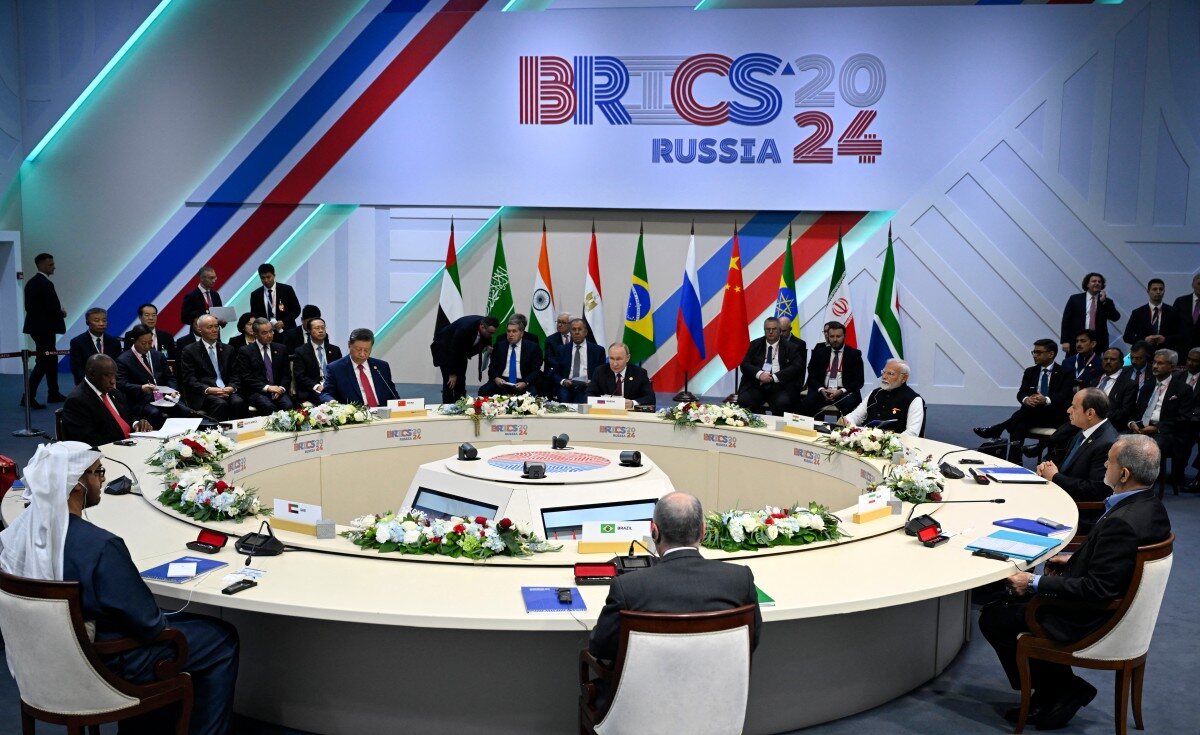
The shift is no longer a forecast. It is an active restructuring of the global financial order. For decades, the world operated on the assumption that trade was a deterrent to conflict, a philosophy often called "peace through commerce." That era is dead. Governments are now pivoting toward a permanent war economy, where defense spending is not a temporary reaction to a crisis but a fundamental driver of national GDP. This transition is siphoning capital away from social infrastructure and private innovation, redirecting it into a closed-loop military-industrial complex that prioritizes state survival over market efficiency.
The End of the Peace Dividend
Since the early 1990s, Western economies enjoyed what economists called the "peace dividend." By slashing defense budgets after the Cold War, nations could funnel trillions into healthcare, education, and tax cuts. That surplus has evaporated. We are seeing a structural realignment where the "just-in-time" supply chain is being replaced by "just-in-case" military stockpiling. For an alternative view, see: this related article.
This isn't just about buying more tanks or drones. It is about the militarization of the industrial base. When a government identifies semiconductors, batteries, or rare earth minerals as "strategic assets" rather than mere commodities, the free market stops functioning. The state steps in with subsidies, protectionist tariffs, and mandates. This creates an environment where the most successful companies are not those that innovate for the consumer, but those that align their R&D with the procurement needs of the Ministry of Defense or the Pentagon.
Inflation as a Weapon of War
One factor the mainstream financial press frequently overlooks is the inherent inflationary pressure of a war economy. Military spending is, by its nature, unproductive in economic terms. If a government spends $100 million on a bridge, that bridge facilitates trade, saves time, and generates long-term economic returns. If that same government spends $100 million on a missile, that missile sits in a warehouse until it is destroyed. The money enters the economy—paying engineers, machinists, and suppliers—but the "product" adds zero utility to the civilian marketplace. Related insight on the subject has been provided by Financial Times.
This creates a classic imbalance: more money chasing fewer goods. When you combine this with the disruption of global energy markets and the weaponization of trade routes, you get a "sticky" inflation that central banks cannot easily fight with interest rates alone. We are entering a period where the cost of living is directly tied to the cost of munitions.
The Shell Game of Defense Budgets
Governments are becoming increasingly creative in how they hide the true cost of this shift. We see "emergency" supplemental packages becoming annual fixtures. We see debt-to-GDP ratios climbing to levels that would have been unthinkable a decade ago. But because this spending is framed as a matter of national survival, the usual fiscal hawks have gone silent.
The real casualty is opportunity cost. Every billion dollars allocated to a new submarine program is a billion dollars not spent on upgrading a power grid or funding basic scientific research. Over twenty years, this redirection of capital stunts a nation’s organic growth potential. It builds a fragile economy that is dependent on the continuation of tension to justify its own structure.
The Technology Trap
There is a popular myth that war drives innovation. While it is true that the internet and GPS have military origins, the modern relationship between the lab and the battlefield has changed. Today, the private sector often outpaces the military. Silicon Valley develops AI and sensor tech faster than the bureaucracy of a defense department can buy it.
This has led to a desperate "dual-use" strategy. Governments are now intervening in the venture capital space, trying to steer startups toward military applications early in their lifecycle. For a founder, this is a poisoned chalice. While a government contract provides stability, it often comes with export restrictions and security clearances that prevent the technology from reaching a global civilian market. The result is a fractured tech ecosystem where the best minds are siloed behind classified walls.
Debt and the New Geopolitics
The financing of this new era is the most dangerous variable. During World War II, nations issued war bonds, effectively asking their citizens to fund the effort. Today, the debt is simply added to the balance sheet and sold to international investors—sometimes the very same adversaries the spending is meant to deter.
Consider the paradox of a nation borrowing money from a rival to build the weapons intended to contain that rival. This creates a financial Mutually Assured Destruction. If the credit flow stops, the defense machine grinds to a halt. If the defense machine grows too large, it bankrupts the nation it was meant to protect. It is a high-stakes gamble with no exit strategy.
The Resource Scramble
We are moving toward a "fortress economy" model. Nations are no longer looking for the cheapest supplier; they are looking for the most ideologically aligned supplier. This "friend-shoring" is dismantling the efficiencies of globalization.
- Energy Sovereignty: The transition to renewables is being rebranded as a security necessity rather than an environmental one.
- Mineral Protectionism: Countries with deposits of lithium, cobalt, and nickel are forming cartels, realizing their soil is more valuable than their currency.
- Food Weaponization: Grain and fertilizer exports are being used as leverage in diplomatic negotiations, turning the global dinner table into a tactical map.
The Human Cost of Economic Pivot
Beyond the spreadsheets, the shift to a war economy changes the social contract. When the state's primary function shifts back to defense, the individual's role shifts toward being a unit of national production. Workforces are retrained for heavy industry and defense tech. Education systems are pressured to produce more engineers for the defense sector and fewer for the arts or humanities.
This creates a rigid society. A war economy requires stability and predictability, which often leads to the suppression of dissent and the tightening of borders. The "open society" of the 1990s was a luxury of a peaceful world. In a world of permanent preparation for conflict, the walls—both physical and economic—only get higher.
Capital's New Mandate
For the investor, the rules have changed. The old "60/40" portfolio or the reliance on consumer discretionary stocks is becoming a relic. In a permanent war economy, the "safest" bets are the ones tied to state necessity. Aerospace, cybersecurity, and energy infrastructure are the new utilities.
However, this comes with a moral and systemic risk. When a portfolio thrives on instability, the investor has a vested interest in the maintenance of tension. This creates a powerful lobby that pushes for continued hawkishness, regardless of the actual threat level. The economy becomes a self-fulfilling prophecy of conflict.
The Fragility of the New Order
The greatest threat to this system is its own complexity. The modern war machine relies on a global web of components. A single precision missile might require parts from thirty different countries. If any one of those links breaks due to a trade war or a local uprising, the entire "permanent" economy stutters.
We are building a world that is heavily armed but fundamentally brittle. We have traded the efficiency of the free market for the perceived security of a fortress, but a fortress is also a prison for the capital locked within its walls. The transition is complete; the consequences are only beginning to manifest in our bank accounts and our daily lives.
Stop looking for a return to "normalcy." This is the new baseline. The global economy is no longer a tool for mutual prosperity; it is a tool for national power, and that power is being measured in the caliber of its steel and the speed of its silicon. The bill is coming due, and it will be paid in the currency of a diminished standard of living and a perpetual state of readiness that leaves no room for the quiet growth of a peaceful civilization.