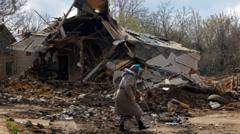
The ceasefire in Eastern Ukraine has collapsed into a grim theater of rhythmic violence where the objective is no longer tactical gain but psychological attrition. While the international community tracks hundreds of individual explosions, the raw data hides a more sinister reality. This is not a series of accidental skirmishes or "trigger-happy" soldiers. It is a calculated, calibrated use of heavy weaponry designed to test the political resolve of the West while grinding down the spirit of those living in the trenches. The accusations flying between Kyiv and Moscow serve as a smoke screen for a conflict that has moved beyond simple territorial disputes into a permanent state of managed instability.
The current escalation follows a predictable pattern of kinetic diplomacy. When diplomatic talks stall in Brussels or Washington, the mortar rounds start falling in the Donbas. It is a brutal feedback loop. By analyzing the specific timing and locations of these "violations," it becomes clear that the shelling is often synchronized with high-level political summits. This isn't war for the sake of conquest; it is war as a messaging service.
The Mechanics of Deniability
In the modern gray zone of European conflict, the weapon of choice is the 122mm howitzer, often fired from civilian-adjacent areas to complicate any counter-battery response. The technical reality of these violations is far more complex than the "he said, she said" reporting found in mainstream outlets. Most of the heavy equipment used in these exchanges should have been withdrawn years ago under previous agreements. Yet, satellite imagery and drone footage consistently show self-propelled guns tucked into tree lines and industrial warehouses within striking distance of the line of contact.
The "why" behind the specific volume of fire—often exceeding 500 explosions in a single twenty-four-hour window—is found in the concept of reconnaissance-by-fire. Forces on both sides use sudden, intense bursts of artillery to force the opponent to turn on their radar systems or move their hidden units. Once a unit moves, its position is logged by electronic warfare suites. The ceasefire violation isn't just a breach of a treaty; it is a live-fire intelligence gathering operation.
The Failure of Observation
The Joint Centre for Control and Co-ordination (JCCC) and international monitors find themselves in an impossible position. They are tasked with counting shells in a region where they often face restricted access. When monitors are blocked from a specific sector, it almost always precedes a heavy barrage. This pattern of "blind-folding" the observers suggests that the escalations are centrally planned rather than the result of local commanders losing their cool.
The technical gap between what is reported and what is happening on the ground is vast. A "violation" might be a single sniper shot or a four-hour long Grad rocket salvo. By lumping these together into a single numeric count, the media misses the shift in lethality. We are seeing a transition from small-arms harassment to the use of heavy, unguided fragmentation shells that carry a much higher risk of collateral damage.
The Economic Toll of Kinetic Pressure
Beyond the immediate casualties, the surge in shelling serves an economic purpose. The Donbas is an industrial graveyard, but it still holds critical infrastructure that services both sides of the contact line. Water filtration plants and electrical substations are frequently caught in the crossfire. By threatening these nodes, combatants can hold entire civilian populations hostage to their demands.
Repair crews often have to wait days for a "window of silence" that never truly comes. This isn't a byproduct of the war; it is a deliberate lever. If you can cut off the water to a city of 100,000 people without officially launching an invasion, you exert massive political pressure on the central government in Kyiv. The shelling is a tool for domestic destabilization, intended to make the cost of defending the region seem untenable to the average taxpayer.
Weaponizing Information in the Impact Zone
Every shell that lands is immediately recycled into the information war. Before the dust has even settled, state-controlled media outlets and Telegram channels are flooded with geo-tagged videos and "expert" commentary. The speed of this reporting suggests a high degree of preparation. In many cases, film crews are embedded with units just minutes before an exchange begins.
This creates a hall of mirrors where the truth is secondary to the narrative of victimhood. The objective is to provide a pretext. For Russia, the narrative is the protection of Russian speakers from "genocide." For Ukraine, it is the defense of sovereign territory against an illegal occupation. The hundreds of violations provide the necessary "proof" for both sides to maintain their respective domestic support.
The Strategy of Permanent Tension
Western analysts often ask when the "real" invasion will start, failing to realize that for the people in the Donbas, the invasion never stopped. The strategy is to maintain a level of violence that is high enough to prevent any foreign investment or normalization, but low enough to avoid triggering a full-scale NATO intervention. It is a delicate, bloody balance.
This managed chaos prevents Ukraine from ever meeting the stability requirements for deeper Western integration. No country can join a defensive alliance while in the midst of an active, shifting border war. The shelling is the physical manifestation of a geopolitical veto.
The Human Cost of Strategic Ambiguity
For the soldiers in the mud, the high-level politics matter less than the caliber of the incoming rounds. Life in the trenches has become a monotonous grind of repair and survival. The psychological impact of constant, unpredictable shelling is profound. Unlike a traditional war with clear objectives and end dates, this conflict offers no exit strategy.
The "violations" are not statistics to them. They are the reason they can’t sleep, the reason the trenches are deeper every month, and the reason the local villages are slowly turning into ghost towns. The attrition of the soul is just as effective as the destruction of the bunker.
The Myth of the Accidental Escalation
There is a persistent theory that these violations are the result of "tensions boiling over" at the local level. This is a misunderstanding of the command structures involved. On both sides, heavy artillery use requires clearance. You do not move a battery of D-30 howitzers and fire forty rounds because you are "tense." You do it because you were ordered to do it.
The escalation is a top-down phenomenon. It is a dial that is turned up or down based on the needs of the Kremlin or the strategic requirements of the Ukrainian General Staff. When the dial is turned up, it is a signal to the world that the current status quo is unacceptable. When it is turned down, it is usually because a specific concession has been made or a new round of talks has been scheduled.
The Role of Modern Technology
The introduction of cheap, commercial drones has changed the nature of these ceasefire violations. Now, every mortar team has an eye in the sky. This has made the shelling significantly more accurate and, consequently, more lethal. A violation that might have missed the target by 200 meters in 2015 now lands directly on the roof of a dugout.
This precision has removed the "accidental" nature of the conflict. When a hospital or a school is hit, it is increasingly difficult to claim it was a stray round. The technology has stripped away the last remnants of plausible deniability, yet the diplomatic language remains stuck in the era of "unidentified masked men."
The Dead End of Current Diplomacy
The existing frameworks for monitoring and stopping these violations are fundamentally broken because they rely on the good faith of the participants. There is no enforcement mechanism. A country can be accused of a thousand violations in a week, and the only consequence is a strongly worded statement from a committee in Vienna.
This lack of accountability has turned the ceasefire agreements into a roadmap for how to fight without getting caught. The participants have learned how to dance around the edges of the rules, using "self-defense" as a blanket justification for any offensive action. As long as the cost of violating the ceasefire remains lower than the perceived benefit of the tactical strike, the shelling will continue.
The international community's obsession with the "count" of violations is a distraction. Whether there are 200 or 2,000 explosions in a day, the underlying reality is the same: the border is a live wound that is being kept open on purpose. The shells will continue to fall as long as the Donbas remains the most valuable piece of leverage in the larger struggle for the future of Eastern Europe.
Stop looking at the numbers and start looking at the map; the geography of the explosions tells you everything you need to know about where the next political fracture will occur.