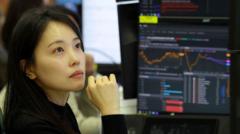
The air in the trading floors of Hong Kong and Tokyo usually smells of ozone, expensive espresso, and the quiet, vibrating desperation of several thousand people trying to predict the future. This morning, however, the atmosphere shifted. It wasn't because of a sudden spike in productivity or a breakthrough in manufacturing. It was because of a few sentences uttered thousands of miles away, suggesting that a long-simmering war might finally be gasping its last breath.
For months, the threat of a full-scale conflict with Iran has been the ghost in the machine. It sat on the shoulders of every broker, a heavy, invisible weight that made every "buy" order feel like a gamble against a ticking clock. But when the rhetoric changed—when the suggestion of a peace reached within weeks hit the wires—the market didn't just react. It exhaled.
Markets are not made of numbers. They are made of blood, sweat, and the collective anxiety of millions of people who just want to know that the world will be roughly the same tomorrow as it is today. When a leader hints that a war is ending, they aren't just shifting geopolitical borders. They are lowering the cost of existence.
The Invisible Strings of the Strait
To understand why a stock in Seoul jumps because of a whispered promise in Washington, you have to look at the map not as a collection of countries, but as a circulatory system.
Consider a hypothetical shop owner in Osaka named Hiro. Hiro doesn't care about the intricacies of Iranian centrifuge programs or the nuances of drone warfare in the Persian Gulf. What Hiro cares about is the cost of the plastic casings for the electronics he sells. Those casings are a byproduct of oil. That oil travels through a narrow strip of water called the Strait of Hormuz.
When the threat of war looms, the insurance on the tankers carrying that oil skyrockets. The shipping companies pass that cost to the refineries. The refineries pass it to the manufacturers. By the time Hiro sees the price tag, the "war" is no longer a headline. It is a physical barrier to his livelihood.
When the news broke that a diplomatic off-ramp was being paved, Hiro’s world became slightly less expensive. Multiply Hiro by a billion, and you have the "jump" in Asian stocks. The Nikkei 225 and the Hang Seng aren't just indices; they are thermometers measuring the fever of global stability. Today, the fever broke.
The Alchemy of Hope
There is a specific kind of magic that happens when uncertainty is replaced by even a fragile certainty. Investors hate bad news, but they loathe mystery even more.
For the better part of a year, the "Iran Premium" has been baked into everything. It is a hidden tax on the global economy. It is the reason why a tech startup in Singapore might hesitate to expand or why a logistics firm in Mumbai keeps its cash in the bank instead of buying new trucks.
The moment the suggestion of a "weeks, not months" resolution hit the screens, that hidden tax began to evaporate. We saw it in the green flickers on the monitors. The KOSPI in South Korea climbed, buoyed by the hope that energy costs—the lifeblood of their massive industrial sector—might finally stabilize.
But this isn't just about cheaper gasoline. It’s about the redirection of human energy. When we stop worrying about whether the sky is going to fall, we start looking at how to build better houses. The rally we saw today across the Pacific is a massive, high-speed bet on human ingenuity over human destruction.
The Fragility of the Green Screen
We should be honest about the ground we are standing on. It is thin.
A "suggestion" that a war could end is not the same thing as a signed treaty. It is a signal, a flare sent up into a dark sky. The markets responded to the light, but the darkness is still there.
History is littered with "peace in our time" moments that turned into decades of renewed friction. The traders pushing the "buy" button today are well aware of this. They aren't naive. They are simply opportunistic. In the world of high-finance, a window of peace that stays open for only six months is still a window you can drive a lot of profit through.
There is a certain coldness to it, isn't there? The idea that we quantify the end of human suffering in basis points and dividend yields. But if you look closer, there is also something profoundly human about it. It is the ultimate consensus. Thousands of people, who disagree on politics, religion, and culture, all agreed on one thing this morning: peace is more profitable than war.
Beyond the Ticker Tape
If you were to walk through the central business district of any major Asian city today, you wouldn't see people dancing in the streets because of a diplomatic breakthrough. The shift is subtler.
It's the way a fund manager decides to finally green-light a project in renewable energy because the macro-risks seem just a bit more manageable. It’s the way a family in Manila decides that maybe, just maybe, it’s a safe time to take out that small business loan.
These are the ripples. The stock market is just the first stone dropped into the pond.
We often talk about "the economy" as if it is a weather system, something that happens to us, beyond our control. But the economy is just us. It is the sum total of our confidence and our fears. When we see stocks jump on the news of a potential peace, we are seeing a global vote of confidence in the possibility of a calmer world.
The numbers on the screen are just the shadow of a much larger story. It is a story about the desire for stability in an unstable age. It is a story about how the words of a few can change the fortunes of the many.
Tonight, somewhere in a port in the Middle East, a captain is looking at a chart, wondering if the waters ahead will be a little less treacherous. And in an office in Hong Kong, a junior analyst is finally turning off their monitor, feeling a weight they didn't even realize they were carrying lift, if only for a few weeks.
The fire isn't out yet. But for the first time in a long time, we can see the people through the smoke.